Here’s what happened in crypto today

Today in crypto, US Senate lawmakers likely need to meet three conditions before the chamber could vote on a digital asset market structure bill, Coinbase was sued in California federal court and Strategy executive chairman Michael Saylor toyed with the idea of selling some Bitcoin to “inoculate” the market.
US Senator says crypto market structure vote could happen by August
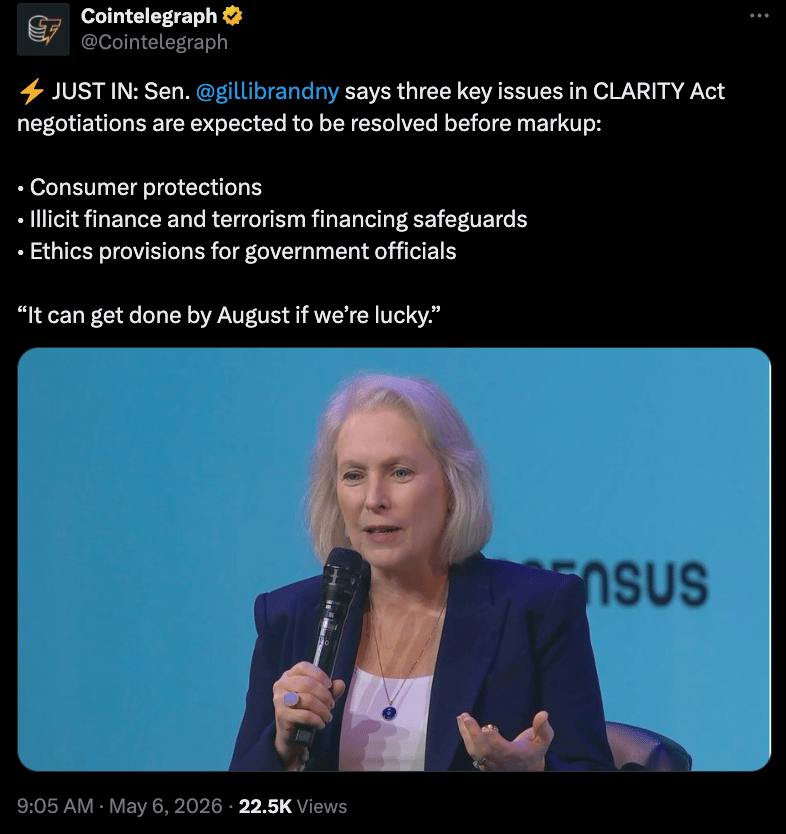
US Senator Kirsten Gillibrand said lawmakers working towards passage of a digital asset market structure bill likely need to meet three conditions before the chamber could vote on the legislation.
Speaking at the Consensus conference in Miami on Wednesday, Gillibrand said she considered addressing consumer protection, illicit finance, and ethics provisions essential before any potential vote on the CLARITY Act.
She said that if Congress were to consider those issues, as well as combine the draft of the market structure bill with the version already passed in the Senate Agriculture Committee and ensure ethics language, lawmakers could have a vote “before the August recess,” which begins Aug. 10.
“There will be no one voting for this bill if we don’t have an ethics provision,” said Gillibrand. “Because the truth is, is that we cannot allow members of Congress, senior administration officials, presidents or vice presidents, to get rich off of these industries because of their insider status. It is the worst form of pay for play.”
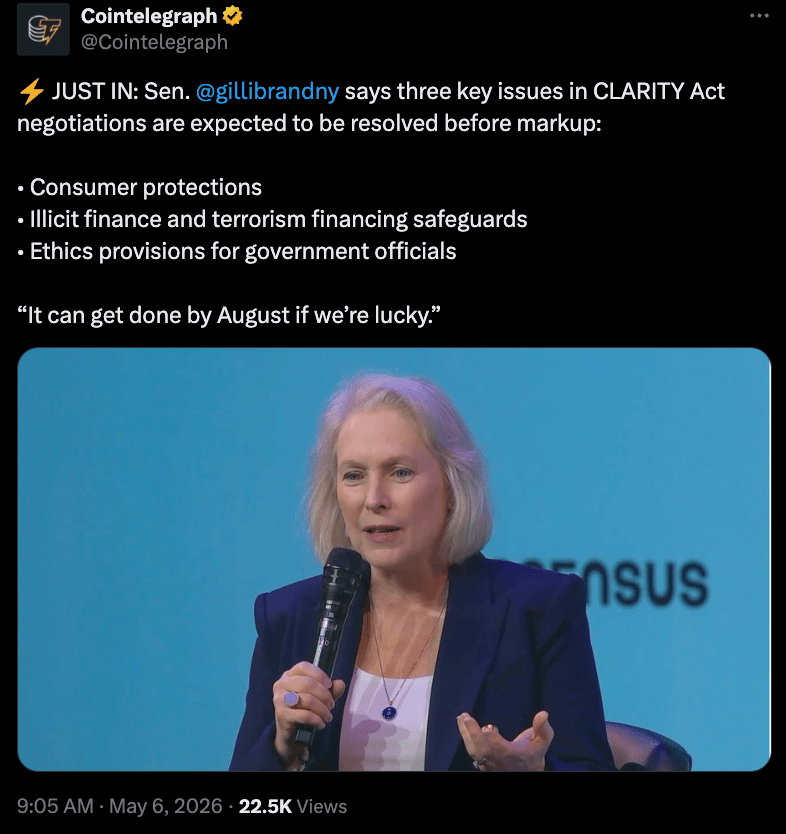
Senator Kirsten Gillibrand speaking on Wednesday. Source: Cointelegraph
Coinbase faces lawsuit over frozen funds from $55 million crypto theft
Cryptocurrency exchange Coinbase was sued in California federal court over frozen crypto allegedly tied to a $55 million DAI phishing theft from August 2024.
The complaint, filed Monday in a San Francisco federal court, alleges that after laundering the proceeds through crypto mixer Tornado Cash, the attacker deposited part of the “traceable stolen funds” into a Coinbase retail user account, where the funds remain frozen.
The Puerto Rico-based plaintiff is asking the court to declare him the rightful owner of the frozen assets and order Coinbase to return them. The lawsuit also names an unknown John Doe defendant accused of carrying out the theft.
The lawsuit questions the responsibility of cryptocurrency exchanges in handling stolen funds that were traceably sent to these platforms after an exploit. The complaint claims that Coinbase has “acknowledged” that it holds these traced funds and has “indicated that a court order adjudicating ownership is required before it will release the frozen assets.”
The case highlights a problem in crypto theft recovery where exchanges may freeze suspected stolen funds after receiving alerts, but often require a court order before releasing assets to a claimant.
The lawsuit comes nearly two years after an exploiter stole $55 million in Dai stablecoins through a sophisticated phishing attack that deceived the victim into clicking a malicious link to a fraudulent DeFi Saver login, authorizing the attacker to gain access to his account and wallets.
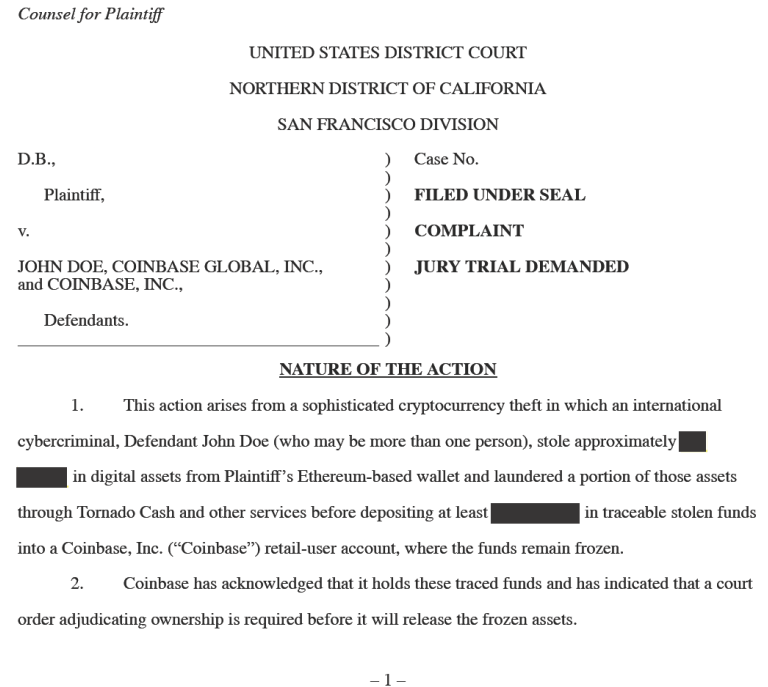
Coinbase sued for funds linked to the $55 million DeFi Saver hack. Source: CourtListener
Strategy could sell Bitcoin „just to inoculate the market“ — Michael Saylor
Strategy executive chairman Michael Saylor said his firm could sell Bitcoin to “inoculate” the market against sudden panic or to reinforce confidence in the company, in contrast to its long-standing “never sell” Bitcoin strategy.
“We’ll probably sell some Bitcoin to fund a dividend, just to inoculate the market, just to send the message that we did it,” Saylor said during the Strategy’s first-quarter earnings call on Tuesday.
Market participants will realize that “the company’s fine, the Bitcoin’s fine, the industry’s fine, the world didn’t come to an end,” Saylor said after Strategy reported a $12.5 billion net loss, driven mostly by unrealized losses on its Bitcoin (BTC) holdings as Bitcoin fell 23.8% in the first quarter.

Michael Saylor (top left) speaking during Strategy’s Q1 earnings call. Source: Strategy
Strategy has been a consistent Bitcoin buying force since August 2020, when it began its strategy of holding Bitcoin as a primary treasury asset.
In February, Saylor dismissed concerns that the company could be forced to sell its holdings during a crypto market downturn, telling CNBC’s Squawk Box, “I expect we’ll buy Bitcoin every quarter forever.“
Saylor also said Strategy could withstand an extreme drawdown in Bitcoin’s price to as low as $8,000 and still cover its debt obligations without needing to sell.