Paybis secures MiCA, payment licenses in Latvia for EU crypto expansion

Cryptocurrency platform Paybis has received two licences from Latvia’s central bank, including one for crypto-asset services under the European Union’s Markets in Crypto-Assets Regulation (MiCA) and another for payment institution operations under Payment Services Directive 2 (PSD2).
The licences were issued by the Supervision Committee of Latvijas Banka on May 12 to SIA Paybis Europe, the company’s EU entity, according to an announcement from the central bank. Paybis is the third company in Latvia to receive a MiCA CASP licence, the central bank said.
The MiCA licence covers custody and administration of crypto assets on behalf of clients, exchange of crypto-assets for funds or other crypto assets, execution of orders, transfer services and crypto asset advisory, Latvijas Banka said. The central bank added that the PSD2 payment institution licence enables Paybis’s EU entity to execute payments and make transfers to payment accounts.
Paybis CEO and co-founder Innokenty Isers said the dual licensing allows the firm “to make a broad, future-focused offering, including working with stablecoins.”
Related: MiCA has made euro stablecoins safe but weak, new report argues
Paybis eyes B2B crypto infrastructure push
Konstantins Vasilenko, co-founder and chief business development officer of Paybis, told Cointelegraph that Paybis is targeting business clients with a white-label crypto infrastructure stack, covering on/off-ramps, buy/sell/swap, payment acceptance and stablecoin payouts. These services would be delivered through a single API, allowing companies to offer crypto services to their own customers without building their own regulated setup.
“This is where the combination of MiCA CASP authorisation and PSD2 PI licensing is particularly important, because it allows us to connect crypto asset services with regulated payment rails,” he added.

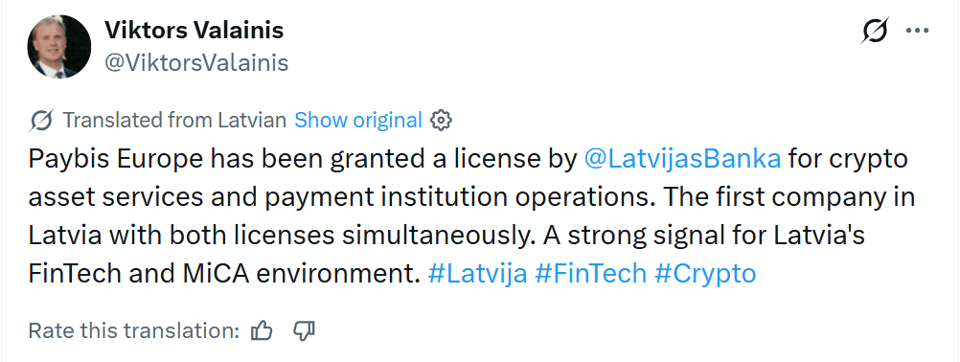
Source: Viktors Valainis, Minister of Economics of Latvia
Founded in 2014, Paybis supports 90 cryptocurrencies and serves seven million users across 180 countries. It also holds money services business licences in the US and Canada.
Related: MiCA-licensed Banking Circle joins bank stablecoin settlement race in Europe
EU weighs “MiCA 2” amid rising scrutiny
In April, a European Commission adviser said the EU’s MiCA crypto regulation is likely to evolve over time, with the Commission planning a public consultation to assess whether the rules are working for market participants. Speaking at Paris Blockchain Week 2026, Peter Kerstens said it would be “rather unusual” if there were no “MiCA 2” at some point, noting that EU financial legislation typically develops in stages.
The comments came amid growing scrutiny and opposition from the crypto industry. Stablecoin issuer Circle has pushed back on euro stablecoin thresholds, while policymakers debate whether supervision of major crypto firms should be centralized under the European Securities and Markets Authority.
Magazine: Singapore isn’t a ‘crypto hub’ — it’s something better: StraitsX CEO