What Is Theta Token (THETA)? How It Works & What It Does
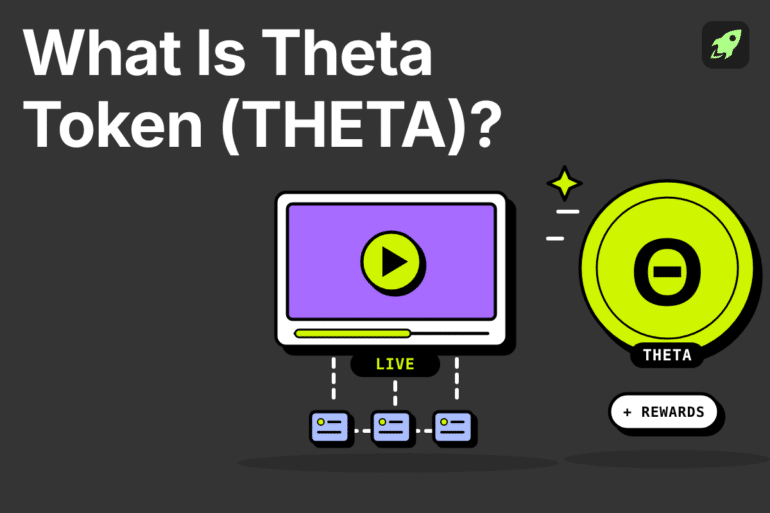
Theta Token (THETA) is the governance and staking token of Theta Network, a blockchain project that started with decentralized video delivery and now also rents out distributed computing power for AI, rendering, and media through a platform called EdgeCloud. If you hold THETA, you don’t pay for anything on the network with it. It secures the chain through staking and gives stakers a say in how the protocol runs. The network’s day-to-day fuel is a second token, Theta Fuel (TFUEL).
That split between two tokens is the part most beginners miss, so this guide walks through it step by step: what Theta Network does, how THETA staking works, why TFUEL exists, and what to check before you buy or stake.
What Is Theta Token (THETA)?
THETA is the native token of the Theta blockchain, a Layer-1 network that went live on mainnet in March 2019. Theta Labs, founded by Mitch Liu and Jieyi Long, created it.
In plain terms, THETA does two things:
- It is staked to Validator and Guardian Nodes, which produce and check blocks on the chain.
- It serves as the protocol’s governance token, so stakers and node operators shape upgrades and network parameters.
The THETA supply is capped at 1 billion tokens, and all of it already exists. No new THETA is minted as a staking reward. Stakers earn TFUEL instead, which is why the two tokens are so tightly linked.
As of late October 2026, THETA trades at around $0.19 to $0.20, with a market capitalization of roughly $190–$200 million, according to CoinGecko. That is far below its all-time high of about $15.90, set in 2021.
How to Get Free Crypto
Simple tricks to build a profitable portfolio at zero cost

Theta Token and Theta Network
People often use “Theta” to mean three different things, which creates confusion:
- Theta Network is the full ecosystem: the blockchain, the edge computing network, the products built on top, and the community that runs nodes.
- Theta blockchain is the ledger itself. It handles staking, payments, rewards, and smart contracts. It is EVM-compatible, meaning developers can deploy Ethereum-style smart contracts on it.
- THETA is the token. It lives on the blockchain and secures it, but it is not the network itself.
When someone says “Theta is a video streaming coin,” they are describing where the project started, not where it is today. That description is incomplete in 2026.
What Does the Theta Network Do?
Theta began with a simple idea: let viewers share spare bandwidth and relay video to nearby users, so platforms spend less on content delivery. People who contributed resources earned TFUEL.
The same infrastructure now handles more jobs. The Theta Edge Network consists of community-run Edge Nodes that contribute bandwidth, storage, and computing power. That network powers Theta EdgeCloud, a hybrid cloud-edge platform for AI inference, model training, video encoding, and rendering. EdgeCloud combines GPUs from community nodes with cloud and data center capacity, and its scheduler routes each job based on hardware, location, availability, and cost.
EdgeCloud has added features steadily through 2026. In March, it launched multi-GPU clusters for model training, and in May it signed its 34th university partner for AI research workloads.
On the blockchain side, Theta also runs the Theta Metachain, introduced with Mainnet 4.0. The Metachain links one main chain to multiple subchains, so partners such as games, media platforms, or compute services can run their own EVM-compatible chains while staying connected to Theta. All subchains use TFUEL for fees.
Under the hood, the blockchain does two jobs that matter for THETA holders.
Staking and Network Security
Theta uses a variant of proof-of-stake called multi-level Byzantine fault-tolerant (BFT) consensus. “Byzantine fault tolerant” means the network can keep agreeing on the correct history even if some participants go offline or act maliciously.
Two groups of nodes run this consensus, and both require staked THETA:
- Validator Nodes propose and finalize new blocks.
- Guardian Nodes seal those blocks and check validators.
The more THETA is staked across honest nodes, the harder it becomes for any single party to rewrite the chain. Staking turns THETA from a tradable asset into a security deposit for the network.
Protocol Governance
THETA is also the protocol’s governance token. In practice, governance on Theta runs through staking and node operation: upgrades are developed by Theta Labs and coordinated with the operators who stake THETA and run the software.
One caveat matters here. Holding THETA in a wallet or on an exchange does not mean you are running a node or automatically casting votes. Influence comes from staking and taking part in the process, not from simply owning the token.
What Is THETA Used For?
THETA has fewer uses than many people expect:
- Staking to Guardian Nodes. Any holder with at least 1,000 THETA can stake to a Guardian Node, either their own or a community node through delegated staking in the Theta Wallet.
- Staking to Validator Nodes. Larger stakeholders and organizations stake THETA to Validator Nodes, which produce blocks.
- Earning TFUEL rewards. Eligible stakers receive a share of newly generated TFUEL.
- Protocol governance. Staked THETA gives node operators a role in network decisions.
- Holding or trading. Like any altcoin, you can hold, trade, or swap THETA on exchanges.
What THETA is not used for matters just as much. You don’t spend THETA on gas, smart contract calls, or EdgeCloud jobs. Those all run on TFUEL. Using the network more does not mean users burn through THETA on each task.
How Does THETA Staking Work?
Crypto staking generally means locking tokens to help run a network in exchange for rewards. On Theta, you stake THETA to a node, and the protocol pays eligible stakers TFUEL over time.
A few mechanics are worth knowing before you start:
- Rewards come in TFUEL, not THETA. The amount depends on your share of all THETA staked across the network.
- Rewards are probabilistic. They are distributed by stake-weighted chance, so small stakers may wait days or even weeks between payouts. Over time, rewards tend to even out in proportion to stake, but nothing is fixed or guaranteed.
- Your tokens stay tied to your wallet. Staked THETA can only return to the wallet that staked it, even if the node itself is compromised.
- Unstaking takes time. There’s no fixed lockup, but withdrawals go through an on-chain cooldown before the THETA returns to your wallet. During that window, you can’t sell or move it.
Rewards are a protocol mechanism, not interest. The TFUEL you receive can rise or fall in value, and governance can adjust reward parameters.
Validator Nodes: Proposing and Finalizing Blocks
Validator Nodes sit at the first layer of consensus. They propose new blocks, vote on them, and finalize them. Up to 31 validators can be active at once, selected by the amount of THETA staked to them. The minimum to become a validator candidate is 200,000 THETA, down from 2 million in 2022, to let more community members participate.
Large organizations run many validators through Theta’s Enterprise Validator program. Google, Samsung, Sony, and Creative Artists Agency have all operated validator nodes, and Deutsche Telekom joined as an enterprise validator in October 2025. Keep in mind that running a node supports the infrastructure. It is not an endorsement of THETA as an investment.
Running a validator requires command-line setup and server-grade hardware, so most holders never operate one directly.
Guardian Nodes: Checking and Sealing Blocks
Guardian Nodes form the second layer. Thousands of community-run Guardians aggregate signatures, seal the blocks that validators produce, and make it much harder for a small group of validators to push through a malicious history.
This is where most retail holders take part. The minimum stake is 1,000 THETA, and the node needs to stay online. If you don’t want to run hardware, the Theta Wallet supports delegated staking to volunteer-run Guardian Nodes, with the same reward terms as running your own.
According to Theta Labs, the TFUEL reward rate per staked THETA is the same whether you stake to a Validator or a Guardian Node. The difference lies in responsibility and requirements, not in payout.
How TFUEL Staking and Edge Nodes Differ from THETA Staking
Theta has a second, separate type of staking that often gets confused with THETA staking.
Edge Nodes don’t secure consensus. They do work: relaying video, encoding, storing data, and running compute jobs for EdgeCloud. They get paid in TFUEL (and sometimes partner tokens) for completed tasks.
An operator can stake 10,000 to 500,000 TFUEL in an Edge Node to upgrade it to an Elite Edge Node. This feature arrived with Mainnet 3.0. Elite Edge Nodes earn extra TFUEL based on their stake and uptime, in addition to payment for actual jobs.
In short, THETA staking protects the ledger, while TFUEL staking supports the work layer. Edge Node earnings depend heavily on how many jobs come in, your hardware, and how reliably the node stays online.
THETA vs. TFUEL: Why Does Theta Have Two Tokens?
The two-token model separates the asset that secures the network from the asset that pays for using it. If gas and compute were paid in THETA, every spike in network activity would pressure the same token validators and guardians stake for security. Splitting the roles keeps those pressures apart.
THETA for Staking and Governance
THETA is the security and governance layer. It has a fixed supply, it gets staked to Validator and Guardian Nodes, and it gives stakers a role in protocol decisions. Its link to network usage is indirect: demand comes from staking and governance, not from paying for transactions.
TFUEL for Gas, Work Payments, and Rewards
Theta Fuel is the operational token. It pays for:
- transaction fees (gas) on the main chain and subchains;
- smart contract operations;
- payments to Edge Nodes for video delivery, storage, and compute;
- staking rewards for THETA stakers and Elite Edge Nodes.
Unlike THETA, TFUEL has no hard cap. It launched with 5 billion tokens and has ongoing issuance, partly offset by burns: at least 25% of qualifying TFUEL payments to the edge network is designed to be burned, and transaction fees create another burn channel. Whether TFUEL supply grows or shrinks over time depends on whether real usage burns more than the network issues.
Theta also has a third token, TDROP, used for marketplace and engagement rewards. It is separate from both THETA and TFUEL and doesn’t affect THETA’s supply.
What Are THETA’s Tokenomics?
THETA’s tokenomics are simple compared with most staking tokens:
- Maximum supply: 1,000,000,000 THETA.
- Circulating supply: the full 1 billion. Every THETA that will ever exist is already out.
- Inflation: none. Staking rewards are paid in newly generated TFUEL, not new THETA.
That fixed supply applies only to THETA. TFUEL follows a different, elastic model, so don’t assume the 1 billion cap covers both tokens.
A fixed supply removes dilution risk from new issuance, but it doesn’t mean the circulating float is static. A large share of THETA sits staked at any given time, and big holders can move tokens in or out of staking. In August 2026, Theta Labs announced plans to unstake 30 million THETA from its treasury to fund growth work for 2026–2027. Events like this can change how much THETA is liquid.
What Should You Consider Before Holding or Staking THETA?
THETA is a volatile asset, and its value depends on more than AI or partnership headlines. Before you buy or stake, check the following:
- Value capture. EdgeCloud jobs are paid in TFUEL. Growth in network usage doesn’t automatically translate into demand for THETA.
- Validator concentration. With a cap of 31 active validators, block production is far more concentrated than on networks with thousands of equal producers. Guardians add checks, but the core set is small.
- Hybrid infrastructure. EdgeCloud mixes community nodes with cloud and data center capacity. Track how much work independent nodes handle, not just announcements.
- TFUEL issuance. Your rewards come in a token with ongoing issuance. If burns don’t keep up, TFUEL’s value can drift lower.
- Treasury moves. Theta Labs holds a sizable THETA treasury, and unstaking or selling from it can affect market supply.
- Liquidity and lockups. Staked THETA enters a cooldown when you withdraw, and smaller stakers may receive rewards irregularly.
- Custody. If you stake through an exchange, you add counterparty risk. Staking from your own crypto wallet gives you self-custody of the keys, but you are responsible for keeping them safe.
Never stake or invest more than you can afford to lose, and remember that no staking reward on Theta is fixed or guaranteed.
Final Words
Theta Token is easier to understand once you separate it from the rest of the network. THETA secures the blockchain through staking on Validator and Guardian Nodes and gives stakers a governance role. TFUEL pays for transactions, smart contracts, and the edge computing that powers EdgeCloud, and THETA stakers also earn it.
The project has moved well beyond its video streaming roots, but THETA’s role has stayed the same: a fixed-supply token that keeps the chain secure. If that model fits your goals, you can buy THETA on Changelly and decide whether to hold it or stake it to a Guardian Node.
Disclaimer: Please note that the contents of this article are not financial or investing advice. The information provided in this article is the author’s opinion only and should not be considered as offering trading or investing recommendations. We do not make any warranties about the completeness, reliability and accuracy of this information. The cryptocurrency market suffers from high volatility and occasional arbitrary movements. Any investor, trader, or regular crypto users should research multiple viewpoints and be familiar with all local regulations before committing to an investment.
The post What Is Theta Token (THETA)? How It Works & What It Does appeared first on Cryptocurrency News & Trading Tips – Crypto Blog by Changelly.
Cryptocurrency News & Trading Tips – Crypto Blog by Changelly