What Is Avalanche (AVAX)? A Beginner’s Guide
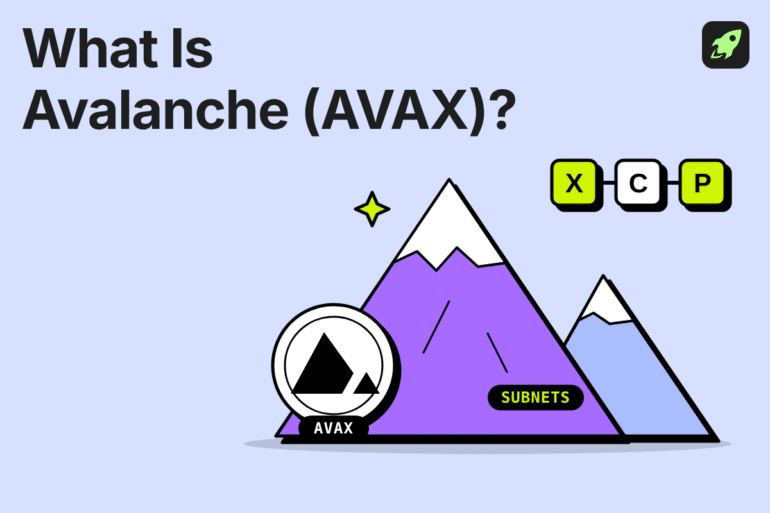
Avalanche is a blockchain network for decentralized applications, and AVAX is its native utility token. People often use the two names interchangeably, but Avalanche is the platform, while AVAX is the asset that pays fees, secures the main network through staking, and serves as a shared unit of account across the chains built on it.
This guide explains how Avalanche is organized, what each core chain does, how consensus and staking work, and what changed with recent upgrades. If you’re new to crypto, you won’t need any prior technical knowledge to follow along.
What Is Avalanche?
Avalanche is an open network that hosts many blockchains at once. Some belong to the Primary Network, the shared base layer that every validator on the main network secures. Others are Avalanche L1s: independent chains with their own validators, rules, and sometimes their own tokens.
Avalanche Mainnet, the production version of the network, launched in September 2020. Ava Labs developed much of the technology behind it and still builds core software such as AvalancheGo, the client that runs Avalanche nodes. Still, the network isn’t a single blockchain operated by one company. Independent validators around the world run it, and protocol changes go through public Avalanche Community Proposals (ACPs).
A simple way to picture it: Avalanche is less like one highway and more like a road system. The Primary Network is the main interchange, and L1s are separate roads that can set their own speed limits and tolls while still connecting to the rest of the system.
Please enable JavaScript in your browser to complete this form.

How to Get Free Crypto
Simple tricks to build a profitable portfolio at zero cost

What Is AVAX?
AVAX is the native token of Avalanche. It is not another name for the blockchain, and it is not required on every chain in the ecosystem. Its job is tied mainly to the Primary Network and to the links between L1s.
How AVAX Is Used
According to the official Avalanche documentation, AVAX has three main roles:
- Paying fees on the Primary Network. Every transaction on the C-Chain, P-Chain, or X-Chain costs a small amount of AVAX.
- Securing the network through staking. Validators lock AVAX to take part in consensus, and their influence is proportional to their share of the total stake.
- Acting as a unit of account across Avalanche L1s. For example, L1 validators pay their ongoing network fee to the P-Chain in AVAX.
AVAX is not automatically the gas token of every Avalanche L1. An L1 can choose its own token for transaction fees. Dexalot, for instance, runs its own L1 with ALOT as the native token.
How Its Supply, Fee Burns, and Staking Rewards Interact
AVAX has a protocol cap of 720 million tokens. Two forces affect how much of it exists at any given time:
- Fee burning. Transaction fees on the Primary Network are burned, which permanently removes them from circulation.
- Staking rewards. Eligible validators and delegators receive newly minted AVAX as rewards, and minting can continue until it reaches the cap.
Because both happen at once, burning fees do not mean the circulating supply must always fall. Whether the total grows or shrinks over a given period depends on how much is burned compared to how much is minted. The Avalanche docs describe the token as likely to stay inflationary for a long time, since rewards are paid continuously while fee burns vary with network activity.
What Is the Primary Network?
The Primary Network is a special Avalanche L1 that forms the base of Avalanche Mainnet. It consists of three blockchains:
These three chains are the Primary Network, not the whole of Avalanche. Many L1s run alongside them. Every Primary Network validator must validate all three chains.
What Is the C-Chain?
The C-Chain (Contract Chain) is where most users interact with Avalanche. It runs smart contracts: self-executing programs that power exchanges, lending apps, NFT marketplaces, and games.
The C-Chain implements the Ethereum Virtual Machine (EVM), the execution environment that runs Ethereum smart contracts. That means developers can deploy contracts written in Solidity and use familiar tools such as MetaMask, Hardhat, and Foundry. For users, a C-Chain address looks exactly like an Ethereum address (it starts with “0x”).
EVM compatibility applies specifically to the C-Chain. Some Avalanche L1s also run an EVM, but others use entirely different virtual machines, so you can’t assume every chain in the ecosystem works like Ethereum.
Fees on the C-Chain are paid in AVAX and use a dynamic pricing model, so they rise when the network is busy and fall when it’s quiet. The Etna upgrade in December 2024 cut the minimum base fee from 25 nAVAX to 1 nAVAX, so basic transactions now cost a fraction of what they used to.
What Is the P-Chain?
The P-Chain (Platform Chain) is Avalanche’s coordination layer. It doesn’t run user apps. Instead, it tracks who validates what. Its main tasks are:
- registering Primary Network validators and recording their stake;
- handling AVAX staking and delegation;
- creating and managing Avalanche L1s and recording their validator sets.
When you stake AVAX, you interact with the P-Chain, even if a wallet app hides that step. The P-Chain also matters for L1s: every L1 validator must sync it so the L1 can take part in cross-chain messaging.
What Is the X-Chain?
The X-Chain (Exchange Chain) is built to create and transfer native digital assets. It uses a UTXO model, similar to Bitcoin, where each transaction spends previous outputs and creates new ones. This design suits simple value transfers rather than complex smart contract logic.
In practice, most everyday users interact with the X-Chain only occasionally—for example, when moving AVAX between chains or when an exchange withdraws AVAX to an X-Chain address (these start with “X-avax”).
How Does Proof of Stake Secure Avalanche?
Avalanche uses Proof of Stake (PoS). In a PoS system, participants called validators lock up the network’s token as collateral to help confirm transactions. The more they stake, the more weight their votes carry.
On the Primary Network, validators stake AVAX. This creates an economic barrier to attacks: anyone who wants to control consensus would need to acquire a large share of all staked AVAX, which is expensive. Validators who stay online and behave correctly can earn staking rewards, while those who fall below the uptime requirement forfeit their rewards for that period.
Avalanche doesn’t slash staked principal. A validator who misses the uptime threshold loses the reward but gets its original stake back at the end of the staking term.
How Does Snowman Consensus Work?
Avalanche uses a family of consensus protocols often called the Snow family. Instead of having every validator talk to every other validator, a node asks a small random sample of validators which option they prefer. If a large enough majority of that sample agrees, the node leans toward that answer. It repeats this many times in quick rounds. Once the same answer keeps winning over enough consecutive rounds, the node treats the decision as final.
Think of a room full of people trying to agree on a color. Rather than holding a full vote, each person keeps asking a handful of random neighbors and switching to the popular choice. Very quickly, the whole room settles on one answer.
Snowman is the version of this protocol designed for linear chains of blocks. It orders blocks on the C-Chain, P-Chain, and X-Chain. Because each round involves only a small sample, the network can reach agreement quickly even with a very large number of validators. Fast finality—meaning confirmed transactions can’t be reversed—is a property of this design. Actual confirmation times still vary with network load, and L1s with different configurations won’t all perform the same way.
How Does AVAX Staking Work?
Staking is how AVAX holders help secure the Primary Network and potentially earn rewards. There are two ways to take part. If you’re new to the concept, our guide to crypto staking covers the basics.
Running a Primary Network Validator
To become a validator on Avalanche Mainnet, you need to:
- stake at least 2,000 AVAX;
- run a node with AvalancheGo that validates all three Primary Network chains (C, P, and X);
- choose a staking period between 48 hours and one year (the minimum dropped from two weeks to 48 hours with the Helicon upgrade in September 2026);
- set a delegation fee of at least 2% if you want to accept delegations.
A validator’s total weight, including delegated AVAX, is capped at the lesser of 3 million AVAX or five times its own stake. So a validator staking 2,000 AVAX can accept up to 8,000 AVAX in delegations.
Delegating to a Validator
If you don’t want to run a node, you can delegate. Delegation lets you assign your AVAX to an existing validator’s stake without handing over custody of the tokens. Delegating requires at least 25 AVAX for a minimum of two weeks and a maximum of one year. The delegation must fit entirely within the validator’s own staking period.
If the validator earns rewards, you receive a share, minus the validator’s delegation fee. Choosing a validator with a long uptime record and a reasonable fee matters, because your rewards depend on its performance.
Reward Conditions, Lockups, and Risks
Staking rewards are not guaranteed. Before you stake, keep these conditions in mind:
- Uptime. A validator must be online and responsive for at least 90% of its staking period to earn rewards (this was 80% for validations that started before Helicon). If your validator misses that threshold, both it and its delegators receive no reward.
- Lockup. Staked AVAX is locked for the whole period. You can’t withdraw early or change the stake amount once you submit the transaction.
- Variable rates. Reward rates depend on the protocol’s rules, your stake duration, and the total amount staked. The Helicon upgrade is also gradually lowering the minimum reward rate over 90 days after activation.
- Market risk. Rewards are paid in AVAX, so their dollar value moves with the token’s price.
If locking tokens doesn’t suit you, some platforms offer liquid staking, which gives you a tradable token representing your staked AVAX. This adds smart contract risk, so research any provider before using it.
What Are Avalanche L1s?
Avalanche L1s (formerly called subnets) are blockchains that run on Avalanche but operate independently of the Primary Network. Each one is a sovereign network with its own validators and configurable rules. In general crypto terms, each is an L1 blockchain: it has its own consensus and doesn’t rely on another chain to settle its transactions.
Teams launch L1s when they need control over things a shared chain can’t offer, such as dedicated throughput for a game, compliance rules for a financial product, or a custom fee token.
Their Own Validators and Security Rules
Each L1 chooses its own validator set. One L1 might be fully permissionless, while another might allow only approved, identified validators. The L1 decides how validators join, how much (if anything) they stake, and in which token.
This also means an L1’s security depends on its own validator set, not on the Primary Network’s. A small L1 with a handful of validators doesn’t inherit the security of Avalanche’s main network just because it lives in the same ecosystem.
Custom Execution, Gas Tokens, and Fees
L1s can also change how they run:
- Virtual machine: an L1 can run an EVM, a modified EVM, or a completely different virtual machine.
- Gas token: an L1 can use AVAX, its own native token, or another asset to pay transaction fees.
- Fee rules: each L1 sets its own fee levels and fee logic.
Because of this, two Avalanche L1s can look and behave very differently, even though both connect to the same broader network.
What the Etna Upgrade Changed
The Etna upgrade, also marketed as Avalanche9000, went live on Mainnet on December 16, 2024. Its biggest change, introduced through ACP-77, was how L1s handle validators.
Before Etna, anyone who wanted to validate a subnet also had to be a Primary Network validator, which meant staking 2,000 AVAX and validating the C-, P-, and X-Chains. That made launching a new chain expensive.
Since Etna:
- an L1 validator no longer has to validate the Primary Network or stake 2,000 AVAX;
- an L1 validator still must sync the P-Chain, so it can take part in Avalanche’s cross-chain features;
- instead of a large upfront stake, L1 validators pay a continuous fee to the P-Chain in AVAX, which the Avalanche docs estimate at roughly 1 to 10 AVAX per month per validator;
- validator sets are managed by each L1, typically through its own smart contract, rather than by a P-Chain owner key.
Etna also introduced dynamic fees on the P-Chain and reduced the C-Chain’s minimum base fee, as mentioned above. Together, these changes made it far cheaper for teams to launch and run their own chains.
What Is Avalanche Interchain Messaging?
Separate L1s are not one shared blockchain, so they need a way to talk to each other. Avalanche Interchain Messaging (ICM) provides that. It lets one Avalanche L1 send an authenticated message to another.
When an L1 wants to send a message, its validators sign it. The receiving chain checks those signatures against the sender’s validator set, which it can look up on the P-Chain. If enough of the sender’s stake has signed, the receiving chain accepts the message as genuine. This is why every L1 validator must sync the P-Chain.
ICM powers cross-L1 token transfers and other interactions within the ecosystem. It works natively between Avalanche chains, unlike a third-party cross-chain bridge that connects separate networks through its own set of contracts and operators.
What Can People Do on Avalanche?
Most activity on Avalanche falls into a few groups:
- DeFi: the C-Chain supports decentralized exchanges such as LFJ, lending protocols such as Aave and Benqi, and stablecoins like USDC and USDT.
- Gaming: several game studios run dedicated L1s to handle in-game transactions without competing for block space. MapleStory Universe, for example, operates on its own Henesys L1.
- Tokenization: financial institutions have used Avalanche for asset tokenization, the process of representing real-world assets like funds or bonds as on-chain tokens.
- Staking: AVAX holders can delegate to validators or run their own nodes.
- NFTs: collectors and creators mint and trade NFTs on C-Chain marketplaces.
To use any of this, you’ll need a crypto wallet that supports Avalanche, such as Core (built by Ava Labs) or MetaMask for the C-Chain. If you plan to hold a large amount of AVAX long-term, a hardware wallet keeps your private keys offline.
You’ll also need some AVAX to pay network fees. You can buy AVAX on Changelly with a card or swap it from hundreds of other cryptocurrencies in a few clicks.
Final Words
Avalanche is a network of blockchains, not a single chain. Its Primary Network has three parts: the C-Chain for EVM smart contracts, the P-Chain for validators and staking, and the X-Chain for native assets. Around it, independent L1s set their own validators, virtual machines, and fees, and use Interchain Messaging to communicate.
AVAX ties the system together. It pays Primary Network fees, secures the network through staking, and serves as the common unit of account across L1s. Its supply is capped at 720 million, with fee burns and staking rewards pulling in opposite directions.
If you want to try Avalanche, start small: get a compatible wallet, buy a little AVAX, and explore a few apps on the C-Chain. Ready to start? Buy AVAX on Changelly in minutes.
Disclaimer: Please note that the contents of this article are not financial or investing advice. The information provided in this article is the author’s opinion only and should not be considered as offering trading or investing recommendations. We do not make any warranties about the completeness, reliability and accuracy of this information. The cryptocurrency market suffers from high volatility and occasional arbitrary movements. Any investor, trader, or regular crypto users should research multiple viewpoints and be familiar with all local regulations before committing to an investment.
The post What Is Avalanche (AVAX)? A Beginner’s Guide appeared first on Cryptocurrency News & Trading Tips – Crypto Blog by Changelly.
Cryptocurrency News & Trading Tips – Crypto Blog by Changelly