What Are Digital Assets? From Cryptocurrency to NFTs and Stablecoins
Digital assets are reshaping how we think about money, ownership, and value. From Bitcoin to NFTs and tokenized real estate, these assets are created, stored, and transferred in digital form—using blockchain technology.
This guide breaks down what digital assets are, the main types of digital assets, how they work, how to store them safely, and why they’re increasingly important for investors and businesses alike.
What Are Digital Assets?
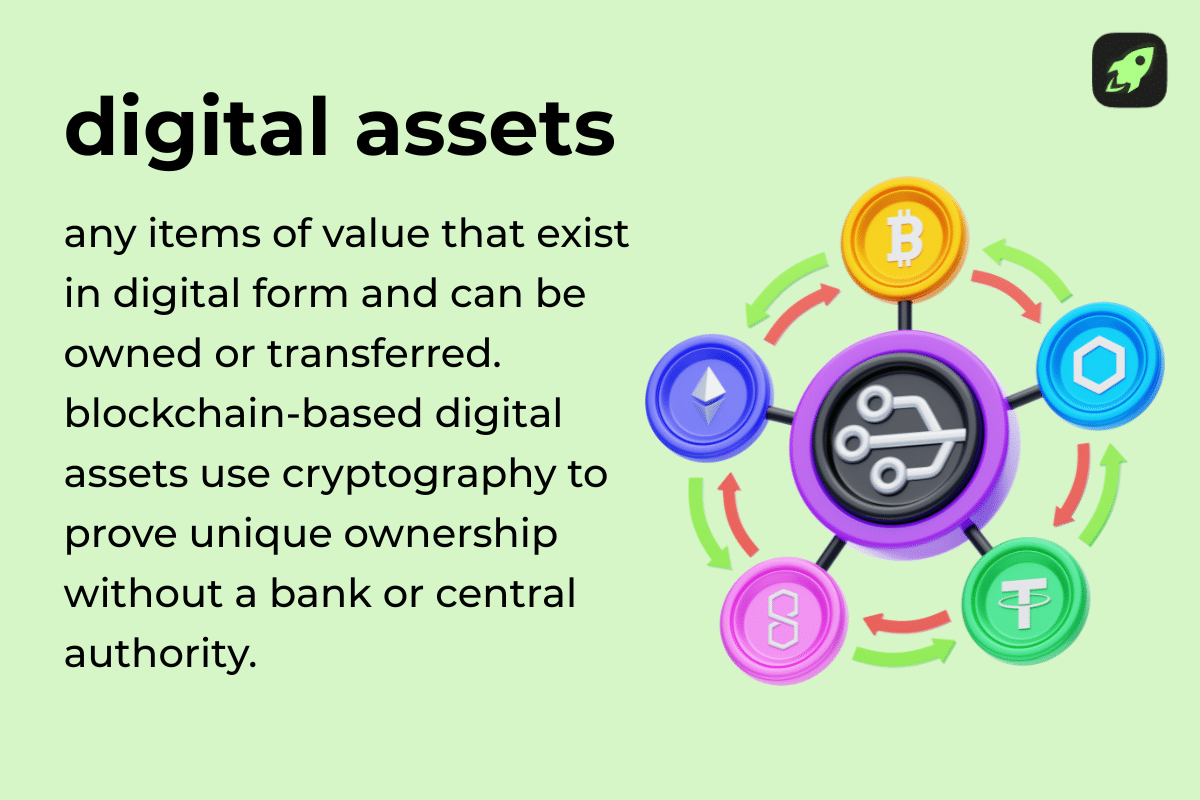
A digital asset is any item of value that exists in digital form and can be owned and transferred. The term covers a wide range of items—from traditional digital files like photos, documents, and gaming accounts to newer digital assets like cryptocurrencies, non-fungible tokens (NFTs), and security tokens built on blockchain or similar technology.What separates blockchain-based digital assets from ordinary ones is how ownership is verified. A photo can be copied endlessly, but a blockchain-based digital asset cannot—unique ownership is recorded on a distributed ledger and proven through cryptography, without any central authority like a bank getting to decide who owns what. Digital assets are created, or “minted,” when new information is added to a blockchain, making each asset’s history traceable and inherently tamper-proof.
Why Digital Assets Matter Today
Digital assets are increasingly important building blocks of modern financial systems, enabling new ownership models, faster transactions, and more open financial applications. Here’s why they matter across four key areas:
Decentralized Finance (DeFi)
Decentralized finance (DeFi) replaces traditional intermediaries with smart contracts, letting anyone lend, borrow, trade, and earn using digital assets.
- Lending and borrowing: Platforms like Compound let users earn interest or borrow against their crypto assets. The terms are executed automatically by immutable code.
- Decentralized exchanges (DEXs): Platforms like Uniswap let users trade digital assets directly via liquidity pools. No central operator controls these exchanges.
- Yield and staking: Users lock tokens into protocols to earn passive income—either through staking or providing liquidity.
- Stablecoins: Assets like USDC and Dai enable stable-value transactions within DeFi without converting to fiat currencies.
- Composability: DeFi apps are modular, and developers can seamlessly combine protocols on-chain to create new tools.
Read more: What Is Composability?
Scalability and Efficiency
Digital assets enable fast, borderless transactions that traditional financial systems struggle to match.
- Fast settlement: Blockchain platforms like Solana and Algorand settle payments in seconds, with no bank holidays or weekends.
- Lower friction: Transfers happen without intermediaries. For example, platforms like MoneyGram have used USDC for rapid cross-border transfers.
- Programmable money: Smart contracts automate trades, loans, and payouts—enabling complex applications that are coded into the blockchain.
- 24/7 transparency: The blockchain never closes. You can track transactions and access sales data in real time, streamlining compliance and data management.
Portfolio Diversification
Digital assets can add new exposure alongside stocks, bonds, and real estate—though they carry more risk and behave more like growth investments.
- Inflation hedge: Bitcoin’s capped supply of 21 million coins leads many investors to treat it as “digital gold”—a store of value that can help offset inflation’s impact on a portfolio.
- Low correlation: Bitcoin and Ether have shown lower correlation with traditional asset classes like stocks and bonds, potentially improving portfolio resilience.
- Small allocation, big potential: For most investors, digital assets comprise just 1–5% of a diversified portfolio—complementing core holdings without overexposing to risk.
- Mutual funds and exposure: An increasing number of mutual funds now offer access to blockchain and tokenization technologies, giving traditional investors indirect exposure to digital assets.
Security and Transparency
Blockchain technology provides strong data integrity. Every transaction is recorded publicly, making fraud harder and data management more reliable.
- Public ledger transparency: Every transaction is logged on a public ledger, visible to anyone. This supports fraud prevention and asset traceability.
- Private key security: Access to your digital assets depends entirely on your private key. Control it, and you control your assets.
- Immutable records: Blockchain’s structure makes historical data extremely difficult to alter, creating reliable records for businesses and individual companies alike.
Main Types of Digital Assets
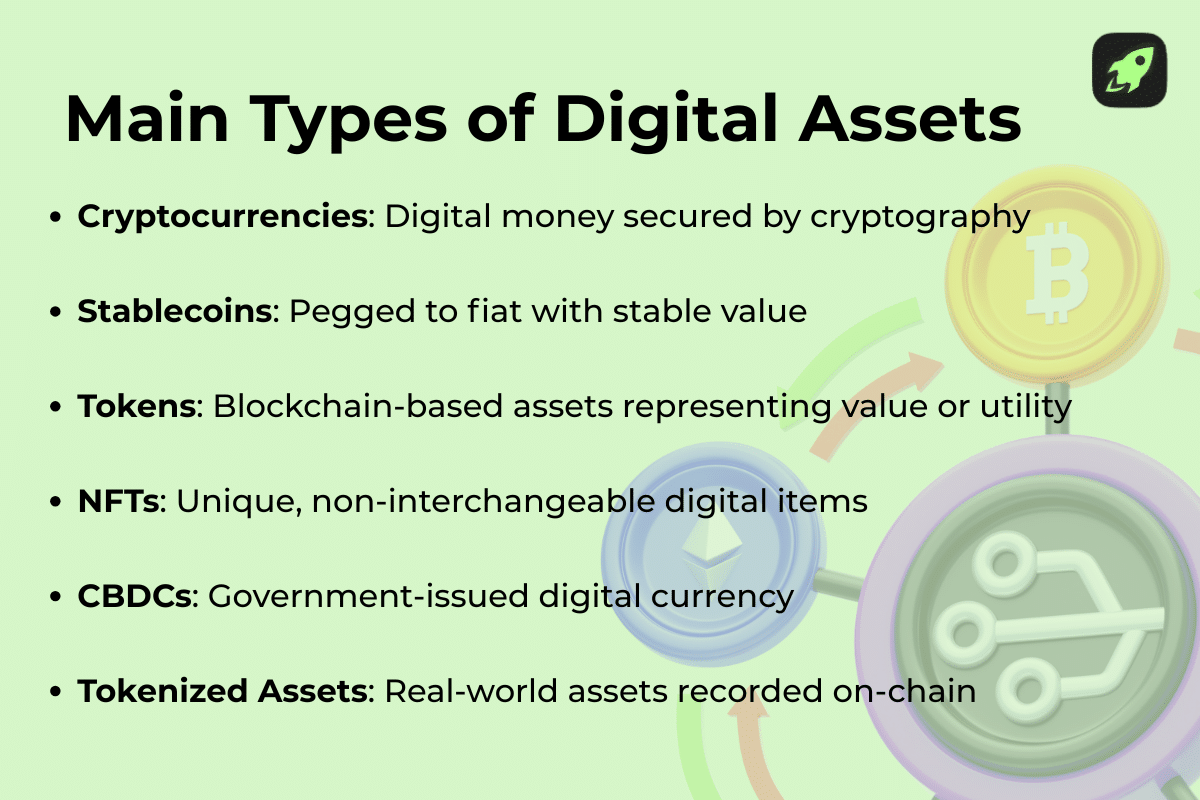
Digital assets aren’t all cryptocurrencies. Understanding each helps clarify what these different asset types represent and how they create value on their own.
Cryptocurrencies
Cryptocurrencies are digital currencies secured by cryptography and operating without central banks or governments. They’re fungible, which means each unit of a given cryptocurrency is identical and interchangeable with another. Any one bitcoin always equals any other one bitcoin. Their value is set by market demand and utility.
Coins and Tokens
Coins run on their own blockchain (e.g., Bitcoin, Ether), while tokens are built on another coin’s blockchain using smart contracts (Uniswap’s UNI, Chainlink’s LINK). Coins typically function as money or network fuel, while tokens can represent almost anything—access rights, governance power, or digital items.
Learn more: Coins vs. Tokens Explained
Examples: Bitcoin, Ethereum.
Bitcoin was created as peer-to-peer digital cash with a fixed supply of 21 million coins. It’s currently the most recognized store of value in the digital asset industry. Ethereum extended the concept further with smart contracts, enabling programmable agreements that execute themselves. In September 2022, Ethereum completed its transition from proof-of-work to proof-of-stake consensus, reducing energy use by approximately 99%.
Tokens
Tokens are digital representations of value or rights issued on existing blockchain networks like Ethereum. There are several distinct token categories:
Utility Tokens
Utility tokens grant access to products or services in a blockchain ecosystem—but not ownership or equity in a company. Filecoin’s FIL token, for example, lets users pay for decentralized data storage. Binance’s BNB offers fee discounts on the Binance exchange. Utility tokens are closer to tools, not investments.
Security Tokens
Security tokens represent ownership in real-world assets or companies—equities, bonds, or real estate—recorded on a blockchain. Importantly, they fall under securities law in most jurisdictions, meaning issuers must comply with regulatory requirements. Security tokens bring traditional financial instruments on-chain, enabling more efficient settlement and broader access.
Governance Tokens
Governance tokens let holders vote on protocol decisions—budgets, features, and upgrades. They are transferable, meaning voting power shifts as tokens change hands. Some protocols give token holders direct control over treasury funds, making these assets critical to decentralized autonomous organizations (DAOs).
Wrapped Tokens
Wrapped tokens are digital representations of assets that have been moved across blockchains. They act as digital receipts. Say you deposit BTC into a smart contract, and receive wBTC (wrapped Bitcoin, an ERC-20 token) which is usable on Ethereum. The value tracks the original asset, and your wrapped coin has more potential utility, but there are also new risks—bridge reliability or third-party custodians.
Stablecoins
Stablecoins are tokens designed to maintain a stable value by pegging their value to fiat currencies like the US dollar—meaning in theory, each individual coin is worth $1. They are among the most commonly used digital assets in both trading and decentralized finance. The two largest stablecoins by market cap are USDT (Tether) and USDC (USD Coin).
How Do Stablecoins Stay Pegged?
Fiat-backed stablecoins like USDC hold reserves—dollars and/or Treasury securities—equal to the number of tokens in circulation. Crypto-backed stablecoins like DAI use over-collateralized digital assets to maintain their peg. Algorithmic stablecoins use code-based mechanisms with little or no collateral—these carry significantly higher risk and have a history of failures.
Read more: Types of Stablecoins Explained
Examples: USDT, USDC, DAI
USDT is the largest stablecoin by volume, pegged to USD, though it offers less reserve transparency than competitors. USDC publishes monthly third-party reserve attestations, making it a more transparent option. DAI is crypto-backed and widely used in DeFi for its decentralized structure.
Non-Fungible Tokens (NFTs)
Non-fungible tokens (NFTs) are unique digital assets—each one has distinct properties and cannot be exchanged one-to-one like cryptocurrencies. Ownership is recorded on the blockchain, giving each NFT a verifiable, immutable history.
What Makes NFTs Unique?
Unlike fungible crypto assets, no two NFTs are identical. Smart contracts track ownership, embed metadata, and can enable optional royalty payments to creators on each resale. Owning an NFT, however, doesn’t automatically grant you copyright or intellectual property rights over the underlying content.
Learn more: Fungible vs. Non-Fungible Tokens: What’s the Difference?
Real-World Examples: Art, Collectibles, Gaming Items
NFTs are used across digital art, music, and gaming. Beeple’s famous “Everydays: The First 5000 Days” sold for $69.3 million in March 2021—one of the most prominent examples illustrating how NFTs can transfer ownership of digital art at scale. In-game items, player skins, and virtual collectibles are also commonly represented as NFTs.
Central Bank Digital Currencies (CBDCs)
Central bank digital currencies (CBDCs) are government-issued digital assets, managed by central banks and accessed through digital wallets. They mirror physical cash but exist in digital form. The Bahamas Sand Dollar—launched in October 2020—was the world’s first CBDC. Sweden’s e-krona and China’s e-CNY have also been introduced in recent years.
- How do CBDCs differ from cryptocurrencies?
CBDCs suit users who want state-backed digital currency. Cryptocurrencies suit those who prefer open, permissionless access.
Tokenized Real-World Assets
Tokenized assets are digital representations of real-world items—real estate, stocks, gold, or art—recorded on a blockchain. Tokenization enables fractional ownership, lowering the barrier to entry for investments previously accessible only to large institutions.
Read more: What Are Real-World Assets?
Examples: Real Estate, Gold, Funds, Supply Provenance
Tokenized real estate allows fractional shares in properties to be traded globally. Tokenized gold assigns digital value tied to physical reserves, enabling easy digital trading. Tokenized funds move fund shares on-chain for greater transparency. Supply chain provenance is another growing use—blockchain provides immutable records for goods tracking. These newer digital assets are democratizing access to specific markets that were historically illiquid or restricted.
How to Get Free Crypto
Simple tricks to build a profitable portfolio at zero cost

How Digital Assets Work Behind the Scenes
The Blockchain
A blockchain is a distributed ledger shared across many computers, recording digital transactions in a secure, tamper-resistant way. Unlike centralized databases, no single entity controls the entire thing. This transparency underpins the entire digital asset ecosystem.
When you send 0.007 ETH to a friend, you submit a transaction to the network. Nodes validate it, it’s added to a block, and the blockchain permanently records it. This way, the transfer is nearly instant, but still publicly verifiable, and virtually impossible to reverse or fake.
Smart Contracts
Smart contracts are self-executing digital agreements coded onto a blockchain. Once the right conditions are met, they execute automatically with no manual intervention or intermediaries. They power everything from DeFi lending to NFT royalties and more.
However, bugs are a major risk of using smart contracts. Problems in the code can lead to major losses. An exploit targeting the blockchain behind the game Axie Infinity in 2022 resulted in $625 million stolen, a clear example illustrating why expert auditing is critical before deploying smart contracts at scale.
Consensus Mechanisms
Consensus mechanisms let nodes on the network agree on the state of the blockchain—validating transactions without a central authority. Here are the two most common types of blockchain consensus:
- Proof-of-work (PoW): Proof-of-work requires miners to solve complex mathematical puzzles to validate transactions and add blocks. Bitcoin uses proof-of-work, making it highly secure but energy-intensive—a long-standing environmental concern.
- Proof-of-stake (PoS): Proof-of-stake selects validators based on the amount of crypto they’ve staked. Ethereum adopted this model in September 2022, cutting energy use by ~99% and reducing its inflation rate from 4.61% to 0.52%. Other blockchains now using proof-of-stake include Solana, Cardano, and Avalanche.
Nodes and Validators
Nodes are the computers that run blockchain software, validate transactions, and keep the distributed ledger synchronized. Validators are nodes that actively confirm new blocks. They’re compensated with network rewards for their bigger role in the process.
Bitcoin’s network counted around 24,000 active nodes globally as of late 2025. This distributed structure makes blockchains resilient—no single point of failure, and no central actor that can shut the network down.
Owning and Storing Digital Assets
Private Keys
A private key is a cryptographic code that proves ownership of the digital assets in a crypto wallet, and authorizes transactions. It’s the equivalent of a password—except there’s no reset button.
If you lose your private key (or seed phrase, which is the 12–24 word backup that unlocks it), you permanently lose access to all the digital assets stored in that wallet. There’s no customer service or options for recovery. This is one of the most critical security measures anyone investing into digital assets must understand.
Wallets
A crypto wallet stores your cryptographic keys: A public key (your receiving address) and a private key (your proof of ownership). Wallets don’t store assets themselves—the assets live on the blockchain.
Hot vs. Cold Wallets
Hot wallets are connected to the internet, making them convenient for frequent access and everyday transactions. Cold wallets are offline, making them far more secure and better suited for long-term storage of larger holdings.
Learn more: Hot vs. Cold Wallets for Crypto
Custodial vs. Self-Custody
With a custodial wallet, an exchange or service holds your private keys on your behalf—simpler to use, but it introduces third-party risk. With self-custody, you hold your own keys and have full control, but if you lose them, all your assets are gone—permanently.
Custodians and Exchanges
Centralized Exchanges (CEXs)
Centralized exchanges like Coinbase or Binance act as custodians, holding your private keys for you. Convenient for beginners, but exchange hacks have historically resulted in significant losses. Assets on a CEX are not insured like bank deposits.
Decentralized Exchanges (DEXs)
Decentralized exchanges like Uniswap let users trade directly from their own wallets. No custodian holds your keys. Trades are executed via smart contracts, giving users full control—but also full responsibility.
Read more: CEX vs. DEX: The Main Differences
Using Digital Assets in Real Life
Payments and Transfers
Cryptocurrencies and convertible virtual currencies enable peer-to-peer cross-border payments without banks—settling in seconds at a fraction of traditional wire costs. This is increasingly important for unbanked populations and global businesses.
NFTs in Everyday Life
NFTs let creators monetize digital items directly—art, music, or in-game assets—without intermediaries. Gaming accounts and in-game economies increasingly rely on NFTs, giving players verifiable ownership of virtual items they can sell or transfer.
Tokenization of Assets
Tokenization allows fractional ownership of property, gold, and other assets—opening specific markets to smaller investors previously priced out. A single tokenized real estate asset can represent fractional shares held by hundreds of investors globally.
Governance and DAOs
Decentralized autonomous organizations (DAOs) use governance tokens to give community members voting power over protocol decisions—budgets, upgrades, and treasury management. These digital assets represent a new model of collective ownership, removing the need for individual companies to make unilateral decisions.
How Do I Actually Buy My First Digital Asset Safely?
You can purchase digital assets like Bitcoin or Ether and many others on Changelly using a bank card, Apple Pay, Google Pay, PayPal, or by swapping from another cryptocurrency. It’s quick and easy—this is all you need to do:
- Open the Changelly website or download the mobile app.
- Create an account (optional, but recommended for easier use).
- Enter your crypto wallet address.
- Choose your preferred payment method.
- Select a digital asset and complete the transaction.
Before buying, review fees, security settings, and withdrawal options. Never invest more than you can afford to lose—digital assets are volatile and prices can shift dramatically in short periods.
Benefits of Digital Assets
- Faster and cheaper global payments: Digital assets cut settlement times from days to seconds and reduce transfer costs, especially for cross-border transactions.
- Financial innovation and new opportunities: Blockchain technology has enabled entirely new financial applications—DeFi, tokenized assets, programmable money—giving individuals and businesses access to services traditional finance doesn’t offer.
- Ownership and control of assets: Self-custody gives users direct control without relying on banks. Tokenization extends this to real-world assets, enabling fractional ownership and broader investment access.
Risks and Challenges of Digital Assets
Digital assets can offer lucrative opportunities—but they come with dangerous risks, too. Before investing, it’s essential to understand what can go wrong:
Volatility and Market Risk
Digital assets are highly volatile. Prices can shift dramatically within hours based on market sentiment, regulatory news, or speculation. Most digital assets have a limited price history compared to traditional asset classes, making risk assessment harder. Even stablecoins have de-pegged under stress in the past.
Security Risk
Digital assets are prime targets for phishing attacks, exchange hacks, fake investment schemes, and “rug pulls”—where project creators disappear with investor funds. Transactions are irreversible, so sending assets to the wrong address or a suspicious project means permanent loss. Unlike bank deposits, digital assets held on exchanges carry no FDIC insurance or equivalent government protection. Strong security measures are essential.
Learn how to protect yourself: Crypto ATM Scams: What They Are & How They Work
Key Management Risk
Unlike a bank password, there is no recovery option for a lost private key or seed phrase. Billions in crypto assets have been permanently lost this way. Back up your seed phrase securely—offline, never shared, never stored online.
Environmental Impact
Proof-of-work blockchains like Bitcoin consume significant electricity. This remains a legitimate environmental concern, though efficiency has improved over time. Proof-of-stake chains offer a far more energy-efficient alternative.
Regulation and Legal Issues
The regulatory landscape of digital assets is evolving quickly. In the EU, the Markets in Crypto-Assets (MiCA) regulation establishes a framework for digital asset oversight. In the US, the SEC continues to evaluate which digital assets qualify as securities. Uncertainty creates legal risk for businesses and investors.
As for taxes, in most jurisdictions, digital asset transactions are taxable events—including trades, sales, and some transfers. Reporting requirements are increasingly enforced. Consult a tax professional for qualified advice on your investments.
Final Thoughts
Digital assets are no longer a fringe concept, but an increasingly important part of the global financial landscape. You’ve already taken the first step to engaging with this space responsibly by understanding the different types of digital assets, how blockchain technology underpins them, and how to store and use them safely.
Whether you’re exploring decentralized finance, considering tokenized real estate, or simply curious about Bitcoin, the same principle applies everywhere: start small, secure your keys, and never invest more than you can afford to lose.
FAQ
Should I keep crypto on an exchange or in a wallet?
Use an exchange for small amounts and active trading. Use a self-custody cold wallet for larger holdings or long-term storage.
Which digital asset is best for beginners?
Bitcoin and Ether are the most established digital assets—greatest liquidity, longest track records, and broadest regulatory certainty. Most beginners start here before exploring other digital assets.
Is it safe to store crypto on my phone?
Not really. It’s convenient for small amounts, but for anything significant, a hardware cold wallet is much safer.
What new types of digital assets might come in the future?
Tokenized real-world assets, central bank digital currencies (CBDCs), AI-integrated tokens, and on-chain identity credentials are among the most watched emerging areas at the moment.
How can I spot a scam project?
Anonymous teams, promises of guaranteed returns, unaudited code, and pressure to act fast are all major red flags—if it sounds too good to be true, it is.
Disclaimer: Please note that the contents of this article are not financial or investing advice. The information provided in this article is the author’s opinion only and should not be considered as offering trading or investing recommendations. We do not make any warranties about the completeness, reliability and accuracy of this information. The cryptocurrency market suffers from high volatility and occasional arbitrary movements. Any investor, trader, or regular crypto users should research multiple viewpoints and be familiar with all local regulations before committing to an investment.
The post What Are Digital Assets? From Cryptocurrency to NFTs and Stablecoins appeared first on Cryptocurrency News & Trading Tips – Crypto Blog by Changelly.
Cryptocurrency News & Trading Tips – Crypto Blog by Changelly