US CBDC ban to go into effect without Trump signoff on housing bill
A bipartisan housing bill containing a ban on a central bank digital currency (CBDC) in the United States is set to become law as the deadline approaches for President Donald Trump to sign it.
Just after midnight on Friday, the 21st Century ROAD to Housing Act will have been in Trump’s hands for 10 days, excluding Sundays, the maximum amount of time a bill can be on the president’s desk without a veto or a signature. Under the US Constitution, the legislation will automatically become law without action from Trump, who canceled the signing ceremony for the bill on Jun 24.
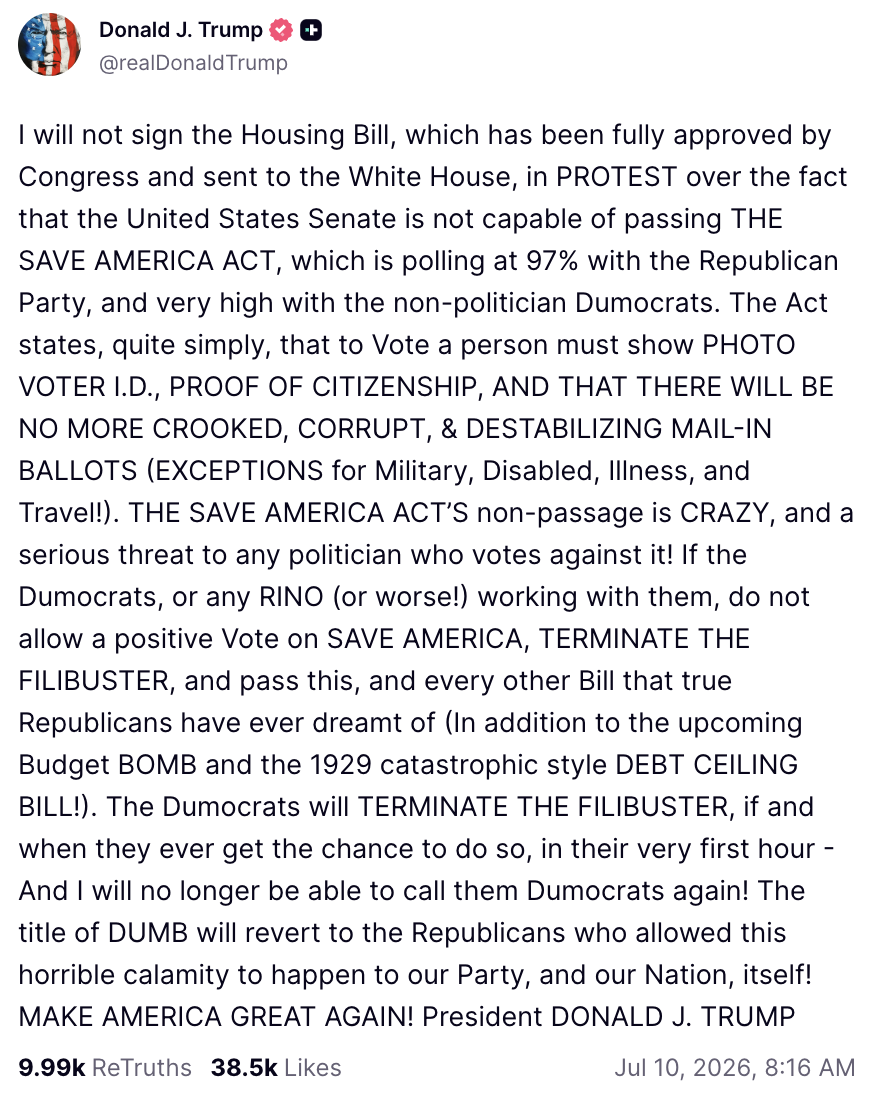
In a Friday social media post, Trump confirmed that he would not sign the housing bill, calling Republicans in Congress who voted on the legislation “dumb” and urging the Senate to instead prioritize a controversial voting bill, the SAVE America Act. The legislation, which would require people to provide proof of US citizenship in person to register, has received widespread criticism for claims that it would disenfranchise citizens already eligible to vote.
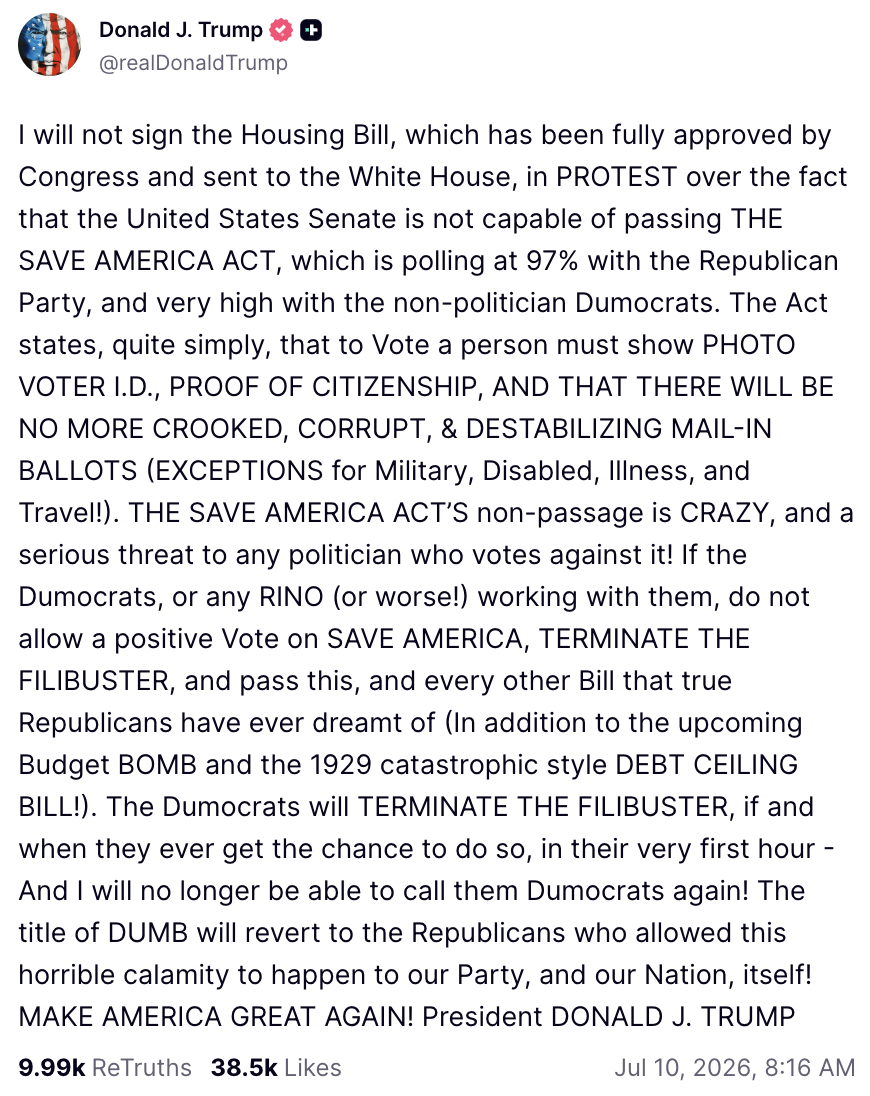
Source: Donald Trump
The housing bill, passed by the House of Representatives and Senate in June with support from Democrats and Republicans, included language barring the Federal Reserve from issuing or creating a CBDC “or any digital asset that is substantially similar” until Dec. 31, 2030. Many analysts saw the digital dollar ban as a political giveaway to gain Republican support. Trump did not address the CBDC ban in his Friday post.
Related: Trump backs CFTC authority over prediction markets
“[H]e’s refusing to sign the biggest housing bill in 30 years,” said Senator Elizabeth Warren, who co-sponsored the bill, on Trump’s actions. “The good news: it’s going to become law anyway.”
Could Trump’s inaction also affect crypto market structure?
Although the US president said in May that he intended to “future-proof” digital asset regulations, his refusal to sign legislation unrelated to the SAVE America Act has raised questions about whether the Digital Asset Market Clarity (CLARITY) Act under consideration in the Senate could face a similar situation as the housing bill.
The CLARITY Act, considered by many to be one of the most significant pieces of legislation affecting digital asset regulation, has already passed the House and two crucial Senate committees. Republican leaders in Congress expect that the bill will be heading to the full chamber for a floor vote in July once lawmakers return from state work periods on Monday.
Trump’s ties to the crypto industry have already complicated discussions between Democrats and Republicans over the market structure bill. The president disclosed earning more than $1.4 billion in income from his crypto ventures in 2025, including memecoins and the family’s World Liberty Financial platform.
Magazine: Crypto’s CLARITY Act faces partisan fight over ethics on Senate floor