What Is TRON and How Does It Work
With a growing selection of blockchains, TRON stands out as one of the fastest-growing networks in crypto. TRON was created in 2018 by Justin Sun—a crypto billionaire, a businessman, and a former representative at the World Trade Organization. TRON is recognized as a fast and secure chain, and in this article, we’ll learn more about its history and how it works.
What Is TRON (TRX)?
TRON is a decentralized blockchain platform that supports applications, digital assets, and smart contracts. Its native cryptocurrency, TRX (Tronix), powers activity across the whole network. You can use TRX to pay for transactions, stake it for resources like bandwidth, and vote on governance decisions.
It was first designed as a decentralized platform for sharing content, but it has since grown into an ecosystem that includes decentralized finance (DeFi). Since its release, TRON has quickly become popular for stablecoin transfers, token issuance, and everyday blockchain transactions with affordable fees.
What Makes TRON Unique?
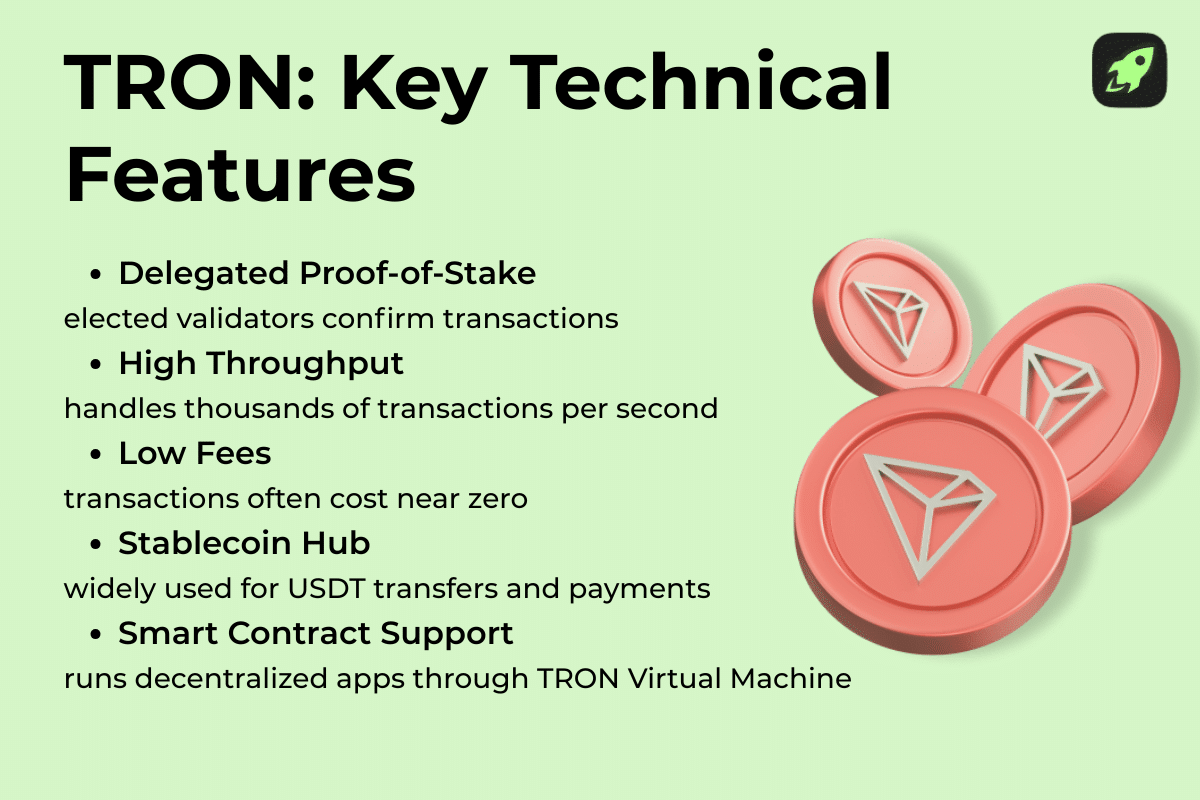
TRON’s protocol prioritizes speed, low costs, and practical blockchain use. It doesn’t charge a fee for every transaction, instead relying on a resource model based on bandwidth and energy, which you obtain by staking TRX. This approach can reduce transaction costs to nearly zero.
At the same time, TRON uses delegated proof-of-stake (DPoS), where a small group of elected validators, called super representatives, quickly produce blocks. This is how the network handles high transaction volumes efficiently, processing up to 2,000 TPS.
TRON primarily stores entertainment applications, which also makes the platform attractive to a lot of users.
How to Get Free Crypto
Simple tricks to build a profitable portfolio at zero cost

TRON’s Mission
TRON (TRX) states that its mission is to enable digital content sharing without centralized intermediaries. The project launched under the TRON Foundation and later shifted to community governance through Tron DAO. The goal stays simple: give users and developers direct control over data, assets, and applications.
By keeping transactions fast and inexpensive, TRON aims to make blockchain technology practical for everyday use—not just technical experiments.
TRON History and Origins
How the TRON Blockchain Works
TRON operates as an independent blockchain platform optimized for speed and low costs. Its architecture separates responsibilities across layers, while its consensus mechanism and resource models reduce friction for daily use. Here’s how the system fits together.
Three-Layer Architecture: Storage, Core, Application
TRON uses a three-layer architecture to keep the network efficient. The storage layer manages blockchain data and account states. The core layer handles consensus, smart contracts, and transaction validation, while the application layer supports decentralized applications.
Virtual Machine (TVM) and Ethereum Compatibility
TRON runs smart contracts through the TRON Virtual Machine (TVM). TVM is essentially the engine that executes dApps. It works a lot like the Ethereum Virtual Machine (EVM), so developers can use familiar tools and the Solidity language to build apps. This significantly lowers the barrier to building on TRON.
Delegated Proof-of-Stake (DPoS) and Super Representatives
TRON uses delegated proof-of-stake to validate transactions and produce blocks. TRX holders vote for a limited number of validators, known as super representatives. This structure enables faster block production and lower costs.
Resource Model: Bandwidth, Energy, Staking, and Fees
TRON does not rely on traditional per-transaction fees. Instead, when you stake TRX, you receive two resources: bandwidth and energy.
- Bandwidth covers simple transactions, like sending TRX or tokens.
- Energy is used for smart contracts and dApps.
Each account gets some free bandwidth daily, and staking gives you more. As long as you have enough resources, you can get low-cost transactions of about 0.82% TRX, which is lower than Ethereum’s gas prices. If you run out of resources, you can cover the cost yourself. This system keeps costs very low while encouraging users to stake TRX and support the network.
TRON Cryptocurrency (TRX)
TRX is the native token of the TRON network. It supports payments, governance, and application activity across the ecosystem. Rather than serving only as a speculative asset, TRX functions as the network’s operational fuel.
Token Utility: Payments, dApps, and Governance
You can use the TRX cryptocurrency to transfer value, stake it to receive resources, and vote for validators. It also powers decentralized applications by covering the resources needed to run smart contracts. This gives TRX ongoing utility within the network.
Token Standards: TRC-10, TRC-20, TRC-721
TRON supports multiple token standards.
- TRC-10 covers basic tokens
- TRC-20 enables smart-contract-based tokens like USDT (TRC-20)
- TRC-721 supports non-fungible tokens (NFTs)
These standards power tokens, stablecoins, and NFTs across the ecosystem.
TRX Tokenomics
TRX has a large total and circulating supply, which is why the price of a single token stays relatively low compared to cryptocurrencies such as Bitcoin. New TRX enters circulation through block rewards, which are payments given to validators (called super representatives on TRON) for producing blocks and keeping the network running.
Users can also stake TRX, meaning they lock their cryptocurrency for a period of time. Staking doesn’t destroy the tokens, but it temporarily removes them from active trading. In return, users receive Bandwidth and Energy, which lets them send transactions and use smart contracts with little or no fees. Staking also gives voting power, allowing users to help choose super representatives.
Because of this design, TRX’s tokenomics prioritize network usage and low costs over strict scarcity. The goal is to keep transactions fast, cheap, and accessible, while encouraging participation through staking rather than limiting supply.
TRON Ecosystem and Use Cases
The TRON ecosystem is built around fast transactions, near-zero fees, and practical everyday uses. Because users don’t pay a fee for every action, TRON works well for apps that need frequent, low-cost activity. Here’s how it’s used in practice:
- Gaming
TRON supports blockchain games where players earn and use tokens or NFTs as in-game items, often with a play-to-earn (P2E) model. Titles like Blockchain Cuties, Cukies World, 0xRacers, Eggies World, and Veni Vidi Vici allow players to earn crypto, trade items, or upgrade characters without worrying about costs. - Multimedia
TRON was designed with digital content creation in mind. Creators can publish videos, music, or other media and receive payments directly from users. Platforms like BitTorrent (which TRON owns) use TRON tokens to reward sharing and downloading, cutting out traditional middlemen in digital entertainment. - Art
NFT marketplaces on TRON allow artists to mint and sell digital art at a much lower cost than on many other blockchains. This makes NFTs more accessible for creators and collectors who don’t want to pay high minting fees. - Finance
TRON is widely used for stablecoin transfers, especially USDT. Users send money quickly and cheaply across borders. DeFi apps also offer token swaps, lending, and yield tools without high transaction costs. - Governance
TRX holders stake their tokens to vote for 27 super representatives, who validate transactions and manage the network together. This gives users a direct role in how TRON operates and evolves.
Risks and Challenges for TRON
Like any blockchain project, TRON has its own risks and challenges that you should consider before getting involved.
- Centralization concerns: TRON relies on a small number of super representatives to validate transactions, which can raise questions about how decentralized the network really is.
- Regulatory uncertainty: Changing crypto regulations could affect TRON’s use, especially for stablecoins and decentralized finance apps.
- Reputation and trust: Past controversies around leadership and marketing have made some users cautious, even if the technology works well.
- Insufficient basics: TRON is often criticized for borrowing developments instead of focusing on the basics of its platform, however, its good user experience and design are usually praised.
- Strong competition: TRON is competing with the Ethereum blockchain, Solana, and other fast networks that also offer low fees and growing ecosystems.
- Token supply pressure: TRX has a large supply, which can limit price growth compared to more scarce cryptocurrencies.
Why People Invest in TRX
People invest in TRX because it plays a central role in the TRON ecosystem. It supports almost all operations within the network, so it has ongoing utility. Some investors also view high transaction volume as a sign of real-world demand.
That said, TRX is still a high-risk asset tied to market conditions and network growth.
How Has TRX’s Price Changed Since Its Launch?
In October 2017, TRX launched with the price of $0.002261 per token. Its price gradually went up along with the market, reaching its ATH of around $0.43 in late 2024–early 2025. Currently, TRX is traded for about $0.30 and its market cap is around $28.79B. TRX has largely been following broader crypto cycles, with price spikes often linked to periods of high network activity.
Check out our TRX price prediction.
Is TRON (TRX) a Good Investment?
Whether TRX is a good investment depends on your goals and risk tolerance. The token has clear utility within the TRON ecosystem and a high market cap, but utility alone does not guarantee price growth. TRX remains volatile and sensitive to market cycles and competition.
Treat it as a high-risk investment and base your decisions on research, not short-term price moves.
How to Buy TRON (TRX)?
You can purchase TRON (TRX) on Changelly using a bank card, Apple Pay, Google Pay, PayPal, or by swapping from another cryptocurrency. Here’s a step-by-step guide:
- Open the Changelly website or app.
- Create an account (optional, but recommended for a better experience).
- Enter your TRON (TRX) wallet address.
- Choose your preferred payment method.
- Select TRX and complete the transaction.
Before buying, review fees, security settings, and withdrawal options. Use a cold wallet for long-term storage or a hot wallet if you plan to trade or use your TRX. You can also buy TRX on other platforms—just make sure to research any exchange before using it.
Final Thoughts
TRON focuses on practical blockchain use through fast transactions and low costs. Its design supports payments, decentralized applications, and stablecoin transfers at scale. If you explore TRON or TRX, start by understanding how the network works and decide how it fits your goals.
Disclaimer: Please note that the contents of this article are not financial or investing advice. The information provided in this article is the author’s opinion only and should not be considered as offering trading or investing recommendations. We do not make any warranties about the completeness, reliability and accuracy of this information. The cryptocurrency market suffers from high volatility and occasional arbitrary movements. Any investor, trader, or regular crypto users should research multiple viewpoints and be familiar with all local regulations before committing to an investment.
The post What Is TRON and How Does It Work appeared first on Cryptocurrency News & Trading Tips – Crypto Blog by Changelly.
Cryptocurrency News & Trading Tips – Crypto Blog by Changelly