
Why Argentina is blocking Polymarket despite its global growth

Key takeaways
Argentina’s nationwide ban on Polymarket shows that rapid global growth does not shield platforms from local regulation, especially when their core activity resembles unlicensed gambling.
Authorities applied an “economic reality” approach, focusing on user behavior rather than the technology, and concluded that staking money on uncertain outcomes aligns with traditional definitions of gambling.
Weak identity and age verification measures were a major concern, with regulators highlighting the risks of underage participation and inadequate user safeguards as justification for enforcement.
Polymarket’s inflation-related markets intensified scrutiny in Argentina, raising fears about insider information, the monetization of sensitive economic data and potential influence on public perception.
Prediction markets are gaining popularity worldwide. People are increasingly using them as high-stakes forecasting tools for topics ranging from politics to the economy.
But in Argentina, that growth has hit a wall. A Buenos Aires court has mandated a countrywide block on Polymarket, arguing that the platform operates as an unlicensed gambling site with insufficient safeguards for its users.
This crackdown underscores a broader global debate over whether prediction markets should be treated as information tools, financial instruments or forms of digital betting.
This article explores why Argentina has blocked Polymarket despite its global growth, examining concerns over unauthorized gambling, weak user protections and inflation-linked bets. It discusses how regulators are increasingly treating prediction markets based on their real-world economic activity rather than their crypto-based structure.
A rapidly expanding platform meets firm legal resistance
Polymarket has established itself as one of the leading crypto-powered prediction markets globally. Participants wager on a wide range of future events, from political elections to macroeconomic indicators, using stablecoins as the medium.
Its swift rise stems from several key drivers:
Growing fascination with instantaneous, market-driven forecasting
Heightened engagement during high-profile international events
The unique appeal of turning knowledge and insights into tradable financial stakes
Nevertheless, this momentum has drawn increased regulatory scrutiny. In Argentina, that scrutiny has escalated into decisive action.
Did you know? Prediction markets date back centuries. In the 1500s, Europeans placed bets on papal elections, showing that wagering on future events long predates modern crypto-based platforms.
Enforcement measures taken by Argentina
A court in Buenos Aires mandated that the national communications authority, Ente Nacional de Comunicaciones (ENACOM), enforce a ban on Polymarket and related domains throughout the country. The directive includes:
Removing or restricting the platform’s applications in the Google and Apple app stores for users in Argentina
Implementing blocks through internet service providers nationwide
The proceedings originated from a formal complaint lodged by Lotería de la Ciudad de Buenos Aires (LOTBA), the Buenos Aires City Lottery authority, with prosecution led by a dedicated gambling crimes office.
Although the ruling came from a municipal court, its enforcement effectively spans the nation, prompting debate over how localized decisions can impose sweeping digital barriers.
Regulators’ rationale for deeming Polymarket unlawful
The core contention is straightforward. When individuals stake real money on uncertain future outcomes, the activity constitutes gambling.
Argentine officials have largely disregarded the underlying blockchain and cryptocurrency elements, instead adopting a practical “economic substance” approach that examines actual user behavior.
Under this view:
Participants commit funds as stakes
Outcomes remain uncertain
Payouts depend directly on event resolution
This framework closely matches conventional legal definitions of gambling. Since Polymarket allegedly operates without the required local licensing or approval, authorities contend that it violates national gambling regulations.
Concerns about identity verification and age controls
A primary focus of the authorities’ critique centers on deficiencies in user safeguards. Regulators argued that Polymarket did not enforce adequate:
Such shortcomings create risks that:
In regulatory environments, these protective gaps are enough to justify intervention, regardless of any cryptocurrency involvement.
Did you know? The US once experimented with political futures markets at the University of Iowa, where participants traded real-money contracts on election outcomes as part of a university-run academic research project.
Heightened scrutiny over inflation-related markets

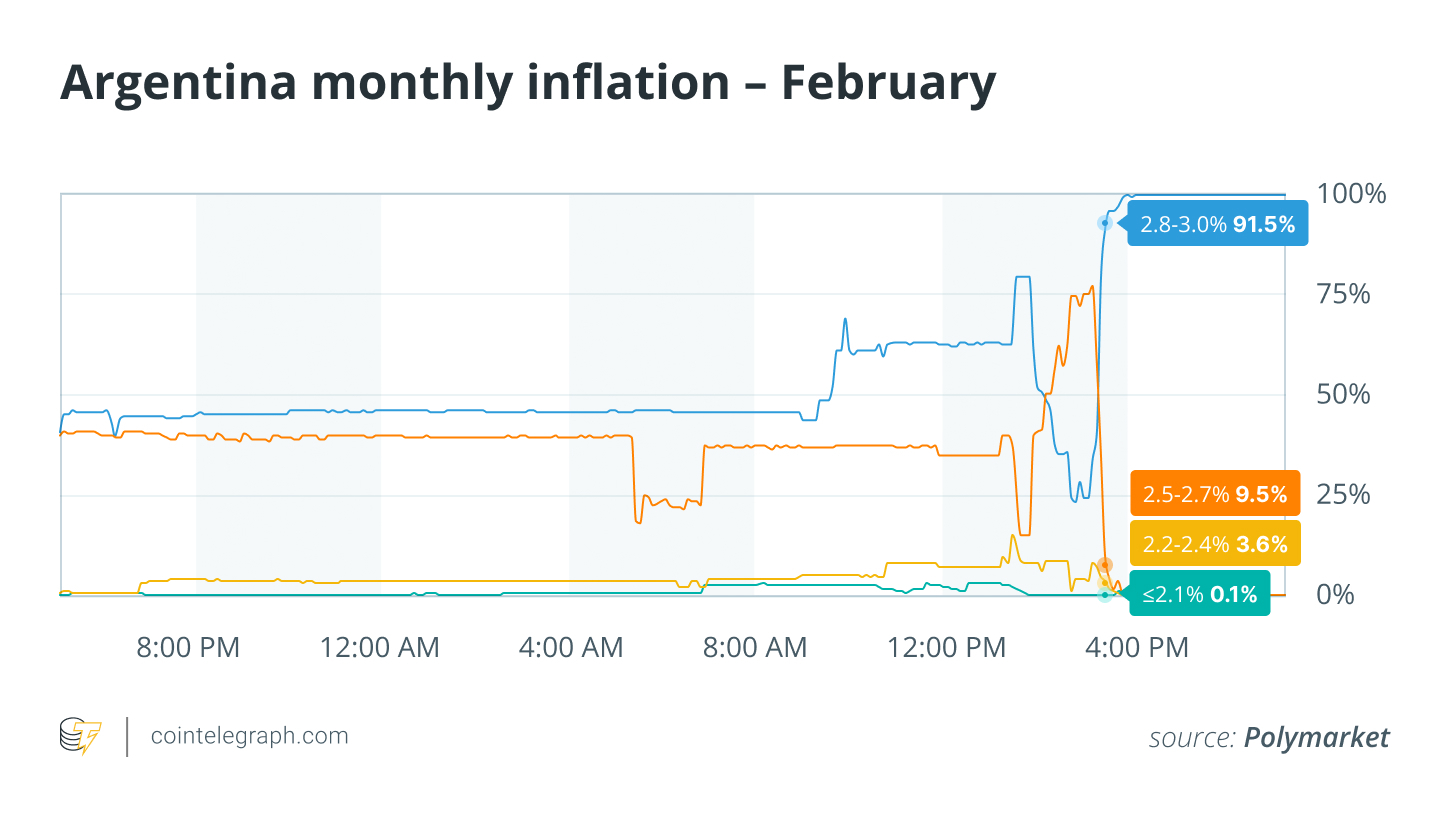
Argentina’s persistent economic challenges, particularly high inflation, make economic indicators politically and socially sensitive. Polymarket featured active markets predicting the country’s official inflation statistics. At times, these market prices aligned remarkably closely with the eventual official releases.
This alignment sparked concerns, including:
Possible access to nonpublic or insider information among participants
The commercialization of sensitive national economic data
The potential for market-driven distortions
Given the significance of inflation in Argentina, this further intensified regulatory alarm.
How global expansion fuels local regulatory pushback
Polymarket’s international prominence is precisely what makes it impossible for regulators to ignore. As the platform expands:
User participation surges
Transaction volumes and capital inflows increase
Public visibility and political attention intensify
An initiative once seen as an innovative venture now appears to be an unregulated betting system that operates outside oversight. In this dynamic, the platform’s rapid growth brought it into the regulatory spotlight.
A growing pattern of global restrictions
Argentina’s measures do not stand alone. Comparable regulatory actions have taken shape in various regions:
Warnings, limitations or outright bans in select European markets
Regulatory interventions across parts of Latin America
Ongoing legal and compliance discussions in the US
This pattern signals a clear regulatory shift. Scrutiny is moving away from technical architecture and toward functional reality. When platform activities resemble gambling or unregulated financial speculation, authorities are more likely to apply corresponding controls.
The enduring dilemma: Gambling versus financial innovation
Prediction markets inhabit a persistent regulatory gray area. Advocates maintain that they deliver substantial value by:
Enhancing the discovery and aggregation of dispersed information
Offering immediate, market-based reflections of collective expectations
Frequently surpassing the accuracy of conventional polling
Opponents counter that they promote:
Purely speculative wagering
Inadequate protections for participants
Vulnerability to insider advantages or market manipulation
This inherent uncertainty complicates classification and makes it easier for authorities to apply preexisting gambling statutes.
Factors driving greater caution in Latin America
Regions such as Latin America exhibit particular regulatory vigilance due to:
Pronounced economic instability and volatility
Acute sensitivity to financial and macroeconomic data
A strong focus on consumer safeguards
Lower tolerance for unlicensed financial operations
In such contexts, platforms involving real-money stakes, even when presented as predictive “markets,” are more likely to face restrictions.
Did you know? Decentralized prediction platforms often use stablecoins instead of more volatile cryptocurrencies to make outcomes easier to calculate and reduce exposure to price fluctuations during trades.
The striking paradox: a municipal ruling with nationwide effect
Issued by a Buenos Aires city court, the order nonetheless resulted in a nationwide block on Polymarket. This illustrates the realities of digital platforms:
Their services transcend borders
Enforcement occurs locally
Consequences extend nationally
It also explains why users quickly turned to tools like virtual private networks (VPNs), highlighting the practical limits of territorial jurisdiction on an interconnected internet.
Implications for prediction markets going forward
The Polymarket episode in Argentina highlights a critical lesson: Expansion alone does not ensure legitimacy or regulatory tolerance. As these platforms continue to scale, they will face:
Increasing regulatory scrutiny
Growing demands for jurisdictional compliance
Stronger requirements for participant protections
Platforms operating in legal gray areas may ultimately have to choose between formal regulation and persistent barriers.
Cointelegraph maintains full editorial independence. The selection, commissioning and publication of Features and Magazine content are not influenced by advertisers, partners or commercial relationships.