
Best Crypto Indicators for Beginners and Intermediate Traders
If you’ve ever bought crypto at the top or sold at the bottom, you’re not alone. Many traders fail because they don’t follow market trends—they just guess. Crypto indicators help remove that guesswork. They show you when to enter, when to exit, and when to wait. This guide covers the most important indicators for traders who want to stop reacting emotionally and start trading with data.
What Are Technical Indicators?
Technical indicators are mathematical calculations based on historical price data.
The indicators are tools that turn price and volume into actionable signals. They first appeared in the stock market, but crypto traders now rely on them daily. They appear as lines, bars, or overlays on charts to simplify market analysis.
For example, moving averages smooth price to highlight trends, while volatility indicators like Bollinger Bands show when markets are quiet or explosive. Other tools measure market momentum, helping you spot when a trend strengthens or weakens.
Indicators don’t predict the future, but they help you react faster to market conditions. Traders combine these signals into trading strategies that guide when to enter or exit a trade.
Top 10 Crypto Trading Indicators for 2026
Moving Averages (MA)
What It Is
Moving Averages (MAs) track the average price of an asset over time, smoothing out short-term fluctuations. This makes it easier to see the market’s direction.
How It Works
In crypto trading, you’ll often hear about the 50-day or 200-day MA. When price stays above a key MA, it usually signals an uptrend. If the price falls below, it may mark a reversal.
Traders often use moving averages to identify potential entry points. For example, a “golden cross” happens when a short-term MA crosses above a long-term MA, hinting at a bullish move. A “death cross” signals the opposite: potential downside.
When to Use It
Moving averages help confirm trends and avoid emotional decisions. They work best in trending markets, not sideways ones. Today, many traders use platforms and apps to set custom MAs and automate alerts. No matter if you’re trading Bitcoin or altcoins, monitoring MAs helps you ride trends and avoid false breakouts.
Relative Strength Index (RSI)
What It Is
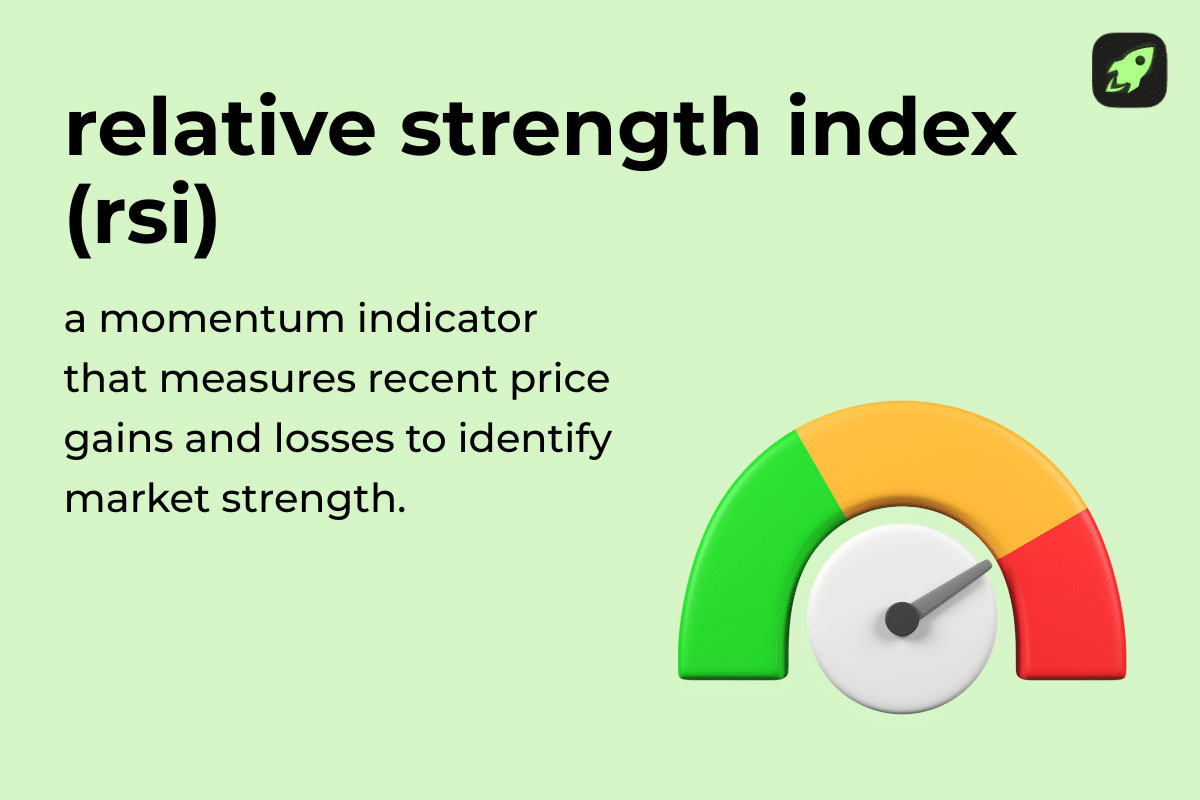
The Relative Strength Index (RSI) is a market sentiment tool that measures momentum. It ranges from 0 to 100 and compares recent gains to losses.
How It Works
When RSI rises above 70, it signals overbought conditions, which means the price could face a price correction. When RSI drops below 30, it shows the market is oversold, often leading to a bounce.
Traders use RSI to time entries and exits. For example, buying when RSI climbs back above 30 can capture the start of a recovery. Selling when RSI drops from overbought can help you exit before a downturn.
RSI also highlights divergences between price and momentum. If the price makes a new high but RSI does not, that’s a bearish signal. If the price makes a new low but RSI stays flat or rises, that’s bullish. This makes RSI valuable in both trending and sideways markets.
When to Use It
Use RSI when you want to spot market reversals, momentum shifts, or entry points in both trends and ranges. It works well across Bitcoin, Ethereum, and altcoins.
Continue reading about RSI in our dedicated article.
Bollinger Bands
What It Is
Bollinger Bands are volatility tools that help you track price trend strength and extremes. They consist of three lines: a middle moving average and two outer bands set at standard deviations from the average.
How It Works
When the bands squeeze together, it signals low volatility. This usually warns that a price breakout is near.
When price breaks the upper band, it suggests aggressive buying by market participants. If it breaks below the lower band, it can signal heavy selling pressure.
Traders use Bollinger Bands to spot potential trend reversals or confirm ongoing trends. For example, if price touches the upper band repeatedly but fails to push higher, a reversal may follow. On the other hand, a strong breakout beyond the bands often confirms momentum in the current price trend.
When to Use It
Bollinger Bands work well in both trending and range-bound markets. They help you decide when to enter after a breakout or wait for a pullback.
Platforms like Binance and TradingView offer Bollinger Bands by default, and it’s easy to add it to your charts.
Volume Indicators
What It Is
Volume indicators track how much of an asset is traded over a specific period. They help you understand market trends by revealing how much real interest is behind a price move.
High trading volume confirms a strong trend. Low volume may signal hesitation or market exhaustion.
How It Works
Tools like On-Balance Volume (OBV) measure whether buyers or sellers dominate. OBV adds volume on up days and subtracts it on down days to show buying versus selling pressure.
If the price rises but OBV stays flat, the rally might be weak. If both price and OBV rise together, the trend is stronger.
Volume spikes often signal new market cycles, especially during breakouts or breakdowns. They highlight when large players—like institutions or whales—enter or exit the market.
When to Use It
Use volume indicators when you want to confirm market volatility or spot false breakouts. A price move backed by high volume is more likely to continue. Weak volume often warns of a failed breakout.
Platforms like TradingView let you overlay volume data easily.
Moving Average Convergence Divergence (MACD)
What It Is
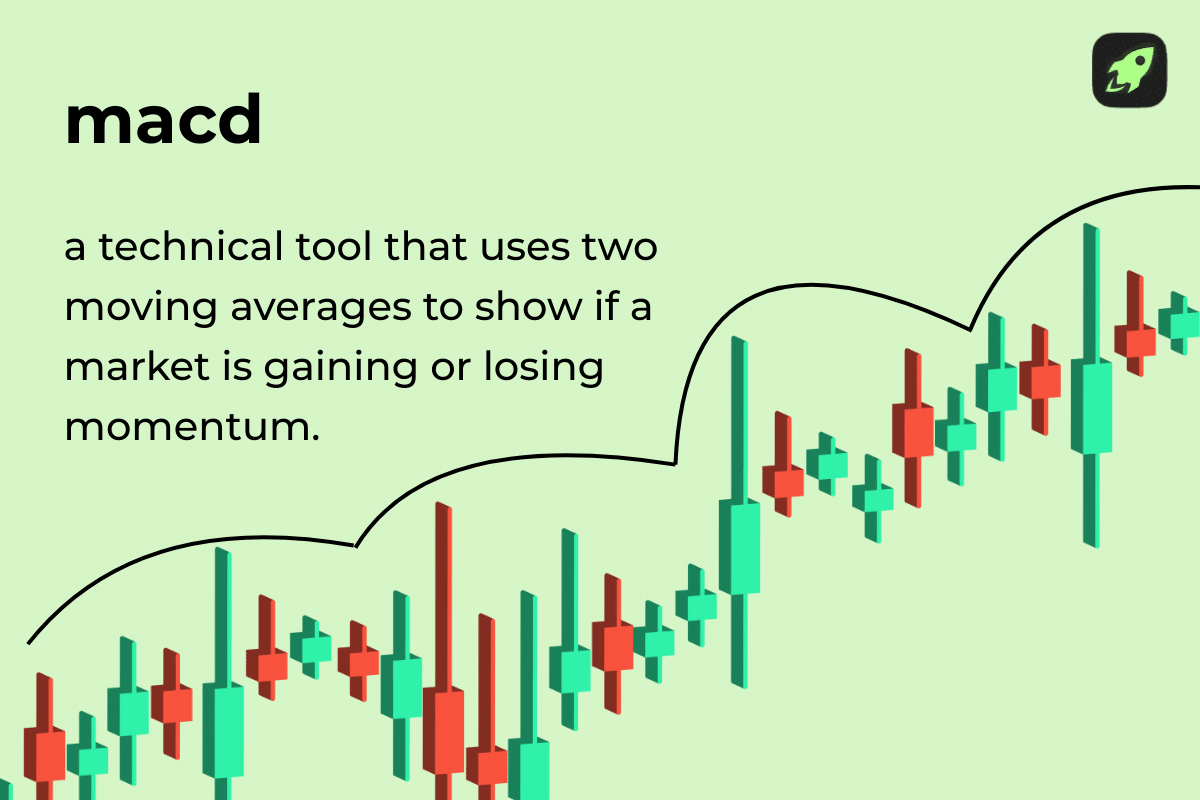
The Moving Average Convergence Divergence (MACD) is a momentum indicator that tracks the difference between two moving averages. It helps traders spot shifts in market momentum and trend direction.
MACD is popular in both crypto and traditional markets because it shows trend strength and reversals in one glance.
How It Works
MACD uses two main elements: the MACD line and the signal line. The MACD line is the difference between the 12-period and 26-period exponential moving averages (EMAs). The signal line is a 9-period EMA of the MACD line.
When the MACD line crosses above the signal line, it suggests bullish momentum. When it crosses below, it signals bearish momentum.
The MACD also includes a histogram that shows the distance between the MACD and signal lines, making it easier to visualize changes in trend strength.
When to Use It
Traders use MACD in various trading strategies to confirm trends, spot divergences, or time entries and exits. For example, a bullish MACD crossover after a pullback can signal a buying opportunity.
Accelerator Oscillator
What It Is
The Accelerator Oscillator (AC) is a momentum tool that helps traders spot early shifts in trend direction. It was developed by Bill Williams and is designed to show changes in market acceleration before the actual trend reverses.
How It Works
The Accelerator Oscillator measures the difference between the Awesome Oscillator (AO) and a 5-period simple moving average of the AO. The result is plotted as green and red bars above or below a zero line.
Green bars above zero mean bullish momentum is accelerating. Red bars below zero show that bearish momentum is gaining strength.
If the bars switch from red to green near the zero line, it can signal that the market is gearing up for a change in trend direction. This gives you a faster signal than traditional trend indicators.
When to Use It
Use the Accelerator Oscillator when you want early warnings of momentum shifts. It works well for anticipating breakouts, confirming entries, or spotting potential reversals.
Many crypto traders combine it with other indicators like MACD or moving averages to strengthen their analysis.
Stochastic Oscillator
What It Is
The Stochastic Oscillator is a trend indicator that measures momentum and helps you spot price extremes. It compares the current closing price to the price range over a set period, usually 14 days.
Traders use it to identify overbought and oversold conditions in crypto markets.
How It Works
The Stochastic Oscillator has two lines: %K and %D. The %K line shows the current closing price’s position within the recent high-low range. The %D line is a moving average of %K, smoothing out the signals.
Both lines move between 0 and 100. When they rise above 80, the market is overbought. When they fall below 20, the market is oversold. These zones signal that the price might reverse soon.
Traders also watch for buy or sell signals from line crossovers. When %K crosses above %D while oversold, it’s a buy signal. When %K crosses below %D while overbought, it’s a sell signal.
This makes Stochastic helpful for finding reversals even when the price trend looks strong.
When to Use It
Use the Stochastic Oscillator when you want to catch short-term market swings or identify exhaustion points in a trend.
It works well in sideways or choppy markets but can also highlight momentum shifts during trends.
Fibonacci Retracement
What It Is
Fibonacci Retracement is a popular tool that helps traders map out potential support and resistance levels during market swings. It’s based on mathematical ratios from the Fibonacci sequence, which appear frequently in nature and financial markets.
In crypto trading, Fibonacci levels help you measure how far a price might pull back after a major move.
How It Works
You plot Fibonacci Retracement lines by selecting two points: the high and low of a price movement. The tool automatically draws horizontal lines at key levels: usually 23.6%, 38.2%, 50%, 61.8%, and 78.6%.
These lines act as potential support or resistance during corrections. For example, after a Bitcoin rally, price often retraces to the 38.2% or 61.8% level before continuing higher.
Traders also look for reactions at these zones to spot trend continuation or reversal.
When to Use It
Use Fibonacci Retracement to identify trading opportunities during pullbacks in an uptrend or bounces in a downtrend. It’s especially helpful for setting entry points, stop-losses, and profit targets.
Ichimoku Cloud
What It Is
The Ichimoku Cloud plots five lines on the chart, each helping you understand current market movements and possible future price action.
- Tenkan-sen (Conversion Line):
This short-term trend line averages the highest high and lowest low over the past 9 periods. It reacts quickly to recent price changes, similar to a fast-moving trend line. - Kijun-sen (Base Line):
This medium-term trend line averages the highest high and lowest low over the past 26 periods. It moves slower than the Tenkan-sen, giving you a broader view of market direction. - Senkou Span A & Senkou Span B (The Cloud or Kumo):
These two lines form the shaded cloud.- Senkou Span A is the average of the Tenkan-sen and Kijun-sen, projected 26 periods into the future.
- Senkou Span B is the average of the highest high and lowest low over the past 52 periods, also projected forward 26 periods.
The space between them creates the cloud, which represents dynamic trend lines and forecasts support and resistance. The thicker the cloud, the stronger the barrier.
- Chikou Span (Lagging Line):
This plots today’s closing price 26 periods back, showing how current prices compare to past market behavior. If the Chikou Span is above previous prices, the market is likely bullish. If it’s below, the trend is likely bearish.
How It Works
- Price Above the Cloud: Signals an uptrend. The cloud acts as support, and traders often look for buying opportunities.
- Price Below the Cloud: Signals a downtrend. The cloud acts as resistance, leading traders to consider selling.
- Price Inside the Cloud: Suggests uncertainty or consolidation. Many traders stay on the sidelines during this phase.
When to Use It
Use the Ichimoku Cloud when you want a full-market view in one indicator. It shows trend direction, momentum, support, resistance, and potential reversals, all at once.
On-Chain Metrics
What It Is
On-chain metrics are unique to crypto markets. They analyze blockchain data directly to give traders insights into market trends. Unlike traditional technical indicators, on-chain data tracks what’s happening behind the scenes, such as wallet activity, token transfers, miner behavior, and exchange flows.
Popular on-chain metrics include:
- Exchange Inflows and Outflows: Track crypto moving in and out of exchanges to gauge potential selling or holding pressure.
- Active Addresses: Monitor wallet activity to see if user engagement is rising or falling.
- Hash Rate (for Bitcoin): Measures network security and miner confidence, often linked to long-term price trends.
- Mean Coin Age: Tracks how long coins have been held; older coins moving may signal major market shifts.
- Whale Transfers: Follow large wallet transactions to spot moves by big players, aka whales.
- Realized Cap vs Market Cap: Shows if the market is overvalued based on actual coin acquisition costs.
- Supply on Exchanges: Declining supply on exchanges usually signals accumulation, while rising supply may warn of false signals.
These metrics help you understand whether traders are accumulating, selling, or moving large amounts of crypto between wallets and exchanges.
How It Works
A common example of an on-chain indicator is On-Balance Volume (OBV), which adds volume on up days and subtracts it on down days. OBV helps show if price moves are supported by real market activity or just speculation.
Other on-chain tools include:
- Exchange inflows and outflows: Large transfers to exchanges can signal selling pressure. Withdrawals to wallets may suggest long-term holding.
- Active addresses: A rising number of active wallets usually reflects growing user interest.
- Whale tracking: Monitoring large wallet transactions can reveal big player moves that shift market trends.
On-chain data can complement price charts but sometimes creates false signals. For example, a sudden whale transfer might look bearish, but if it’s not followed by actual selling, the signal is misleading.
When to Use It
Use on-chain metrics when you want a deeper view of market sentiment beyond price action. They are especially helpful in crypto because blockchain data is public and transparent.
Platforms like Glassnode, CryptoQuant, and Nansen provide real-time on-chain analytics to enhance your trading decisions.

How to Get Free Crypto
Simple tricks to build a profitable portfolio at zero cost


How Technical Indicators Improve Decision-Making
Use Indicators to Find Entry and Exit Points
Technical indicators help you time entry and exit points more effectively. For example, a moving average crossover might signal when to enter a trade, while RSI reaching overbought conditions tells you when to consider exiting.
This prevents emotional trading and helps you act based on data.
Use Indicators to Spot New Trading Opportunities
Indicators highlight setups you might otherwise miss. For example, a price breakout confirmed by high volume can reveal a new trend starting. Combining tools like Bollinger Bands and MACD lets you spot momentum shifts early and prepare for action.
This leads to more informed trading decisions.
Use Indicators to Identify Overbought Conditions
Oscillators like RSI and Stochastic help you identify overbought or oversold conditions. This protects you from buying at the top or selling at the bottom.
When the market is overheated, indicators warn you to reduce risk.
Use Indicators to Detect Bearish Trends Early
Indicators also help you catch the start of a bearish trend. For example, if the price drops below a key moving average and volume spikes, it often signals sellers are taking control.
By recognizing these signs early, you can protect your capital or switch to short-selling strategies.
How to Combine Multiple Indicators for Stronger Signals
Always use multiple indicators together, because no single tool gives perfect signals. Each indicator has strengths and weaknesses. For example, moving averages show trend direction but react slowly. Momentum tools like RSI or Stochastic give faster signals but often produce noise. Volume indicators confirm strength but lag during sideways markets.
By combining other technical indicators, you balance out these limitations.
A common method is to combine one trend indicator, one momentum indicator, and one volume-based tool. For example:
- Use a moving average to spot the overall trend
- Check RSI to see if the market is overbought or oversold
- Look at On-Balance Volume (OBV) to confirm buying or selling pressure
When all three align, you can better forecast future price movements and avoid false signals.
This multi-layered approach helps you understand market dynamics more clearly. It shows not just where the market is going, but whether traders truly support the move.
Most trading platforms let you customize and overlay several indicators to build stronger, more reliable trading strategies.
Common Indicator Problems for Crypto Trading
Technical indicators are powerful, but they’re not flawless. Crypto markets are highly volatile, so indicators can produce false signals more often than in traditional assets. Sudden price swings from whales, news events, or low liquidity can trigger breakouts or breakdowns that reverse quickly.
Another common issue is indicator overload. Using too many tools can lead to confusion and conflicting signals. Stick to a few complementary indicators that cover trend, momentum, and volume.
Lag is also a problem—most indicators rely on historical data, so they respond after the price moves. This can cause late entries or missed opportunities in fast crypto markets.
Finally, some indicators work better in trending markets while others perform in ranges. Using a trend-following tool during sideways price action often gives misleading results.
Practical Tips for Implementing Indicators
- Start simple. Use one trend indicator, one momentum indicator, and one volume indicator to build your foundation. Learn how each works before adding more tools.
- Always backtest your strategies using historical data. This helps you see how indicators perform in different market conditions.
- Pay attention to market context. No indicator works the same way in a bull market, a bear market, or a sideways trend.
- Use alerts to avoid staring at charts all day. Set specific conditions—like RSI crossing 30 or price breaking a moving average—so you get notified only when action is needed.
Final Words
Technical indicators simplify crypto trading by turning raw price data into actionable signals. They help you trade smarter, not harder—but they’re not magic.
Start small, combine tools wisely, and always trade with discipline. Over time, you’ll develop a system that fits your style and keeps you ahead of the market’s next move.
FAQ
Which crypto singal is most accurate?
There is no single crypto signal that’s always accurate. Every indicator has strengths and weaknesses. For example, RSI is good for momentum, while moving averages help confirm trends. Volume indicators can reveal buying or selling strength but often lag. The best strategy is to combine signals from other indicators. Look for confluence. When multiple tools agree, the signal is usually stronger. This reduces false alerts and helps you make smarter trading decisions.
What is the difference between a leading indicator and a lagging indicator in crypto trading?
A leading indicator predicts potential price moves before they happen. Examples include RSI, Stochastic, or Fibonacci levels, which signal possible reversals or breakouts.
A lagging indicator confirms price moves after they occur. Moving averages are classic lagging tools—they show the trend but with a delay.
In crypto, both types are useful. Leading indicators help you anticipate, while lagging ones confirm. Use a mix of both with other indicators to balance early signals with trend validation.
Can I rely on just one indicator when trading cryptocurrencies?
No, relying on one indicator is risky. Crypto markets are unpredictable, and a single tool won’t cover every situation. It’s better to combine other indicators to reduce false signals and improve accuracy. For example, use moving averages for trend, RSI for momentum, and volume to confirm the move. This multi-tool approach helps you trade with more confidence.
Which indicators work best in highly volatile crypto markets?
In volatile markets, choose indicators that adapt to fast price fluctuations. Bollinger Bands help you track volatility spikes, while ATR (Average True Range) measures the size of price swings. Volume-based tools also work well because they show when traders commit real capital. Short-term moving averages can help you keep pace with rapid changes.
How should beginners start using indicators without getting overwhelmed?
Start by adding one or two indicators to your price charts. Focus on learning how each tool works before adding more. Keep your setup simple to avoid confusion. Always manage risk by setting stop-losses and controlling trade size. Remember, learning indicators is a long-term trading journey, so take it step by step and refine your strategy over time.
Do technical indicators work for all cryptocurrencies, or only the major ones like Bitcoin and Ethereum?
Technical analysis works for any cryptocurrency with price history. However, signals are usually more reliable in high market cap coins like Bitcoin and Ethereum due to greater liquidity. Small-cap altcoins often have more volatility and less consistent chart patterns, which can make indicators less accurate. Still, the same tools apply—you just need to adjust your strategy for each asset’s behavior.
Disclaimer: Please note that the contents of this article are not financial or investing advice. The information provided in this article is the author’s opinion only and should not be considered as offering trading or investing recommendations. We do not make any warranties about the completeness, reliability and accuracy of this information. The cryptocurrency market suffers from high volatility and occasional arbitrary movements. Any investor, trader, or regular crypto users should research multiple viewpoints and be familiar with all local regulations before committing to an investment.
The post Best Crypto Indicators for Beginners and Intermediate Traders appeared first on Cryptocurrency News & Trading Tips – Crypto Blog by Changelly.
Cryptocurrency News & Trading Tips – Crypto Blog by Changelly